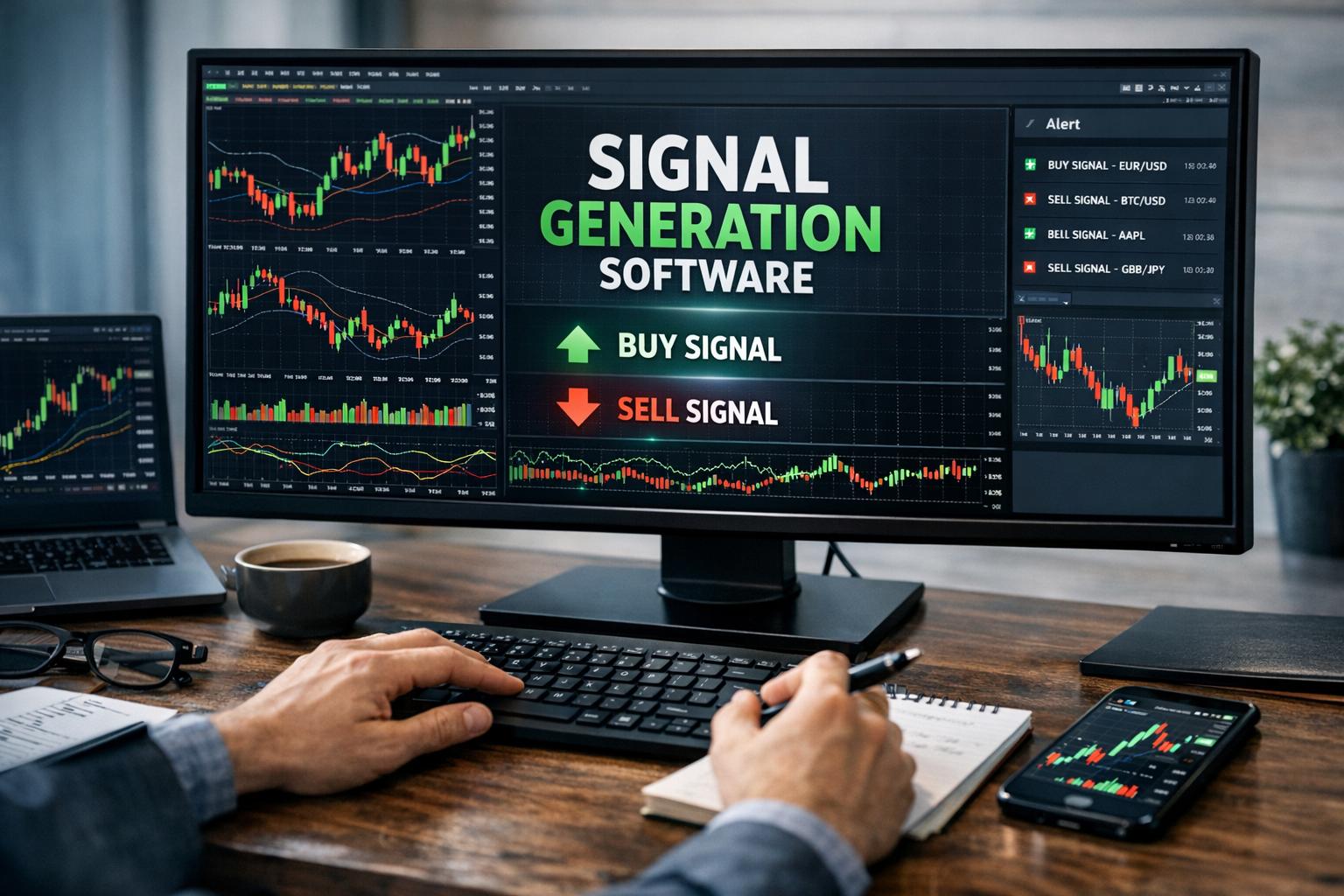
You can build your own signal generation software, even if you’ve never touched a trading platform’s internals. The annoying part isn’t the coding so much as getting crisp about what a “signal” actually means, how it’s created, and how you’ll measure whether it’s worth trusting. If you do that upfront, you’ll avoid the classic situation where you ship a fancy-looking strategy that never survives contact with live markets.
This article walks through how to design, implement, test, and run signal generation software for trading and investing systems. We’ll keep the discussion practical: data inputs, feature engineering, signal rules, risk-aware execution hooks, and the engineering pieces that prevent your backtest from turning into a bedtime story.
What “signal generation” really means
A trading signal is some computed output that tells your system one of two things: when to take an action, or how strongly to bias an action. “Action” could be buy/sell, adjust position size, open/close, or shift between strategies. “Bias” could be a probability estimate, expected return score, or a weighted vote across multiple models.
In most retail and semi-pro setups, signal generation software sits between:
– Market data (price, volume, order-book features if you have them)
– Strategy logic (rules or models that decide)
– Downstream execution (broker API, trade manager, risk checks)
Your software’s job is not to “predict the market” in a magical sense. It’s to produce repeatable outputs from historical and real-time data in a way that you can test, audit, and monitor.
Decide what you’re building: rules vs models
Before writing code, pick the approach. You’ll still be able to mix approaches later, but starting with a clear target prevents endless architecture churn.
Rule-based signals
Rule-based signals produce discrete events from deterministic logic. Examples:
– Moving-average crossover with filters
– RSI thresholds plus volatility regime filter
– Breakout levels based on rolling highs/lows
– Mean reversion using z-scores with a stop/exit plan
These are usually easier to validate and explain. They also tend to be faster in production, which matters if you have many symbols and you want low latency.
Model-based signals
Model-based signals use statistical learning or ML. You might output:
– Classification: next-period up/down
– Regression: expected return over a horizon
– Ranking score: which assets are more attractive
– Probability: chance of meeting certain return thresholds
Model-based systems can adapt better, but they demand more work: data pipeline integrity, feature stability, model evaluation, and ongoing monitoring.
Define signals in contract form
A signal generator should behave like a component with a clear contract. If you’re working solo, writing this down still saves you time. A common pattern:
– Inputs: time series (OHLCV or richer features), current timestamp, instrument identifier
– Internal state: rolling windows, last computed values if incremental processing
– Output: one or more signal fields such as
– direction (long/short/flat)
– strength (0–1, or -1 to 1)
– confidence (optional, depends on your modeling)
– timestamp and horizon used for the decision
– version of the strategy logic (so you can reproduce results)
If your software can’t reproduce the same output for the same input snapshot and version, it’s going to be a nightmare to debug later.
Choose your data flow architecture
Signal generation can be batch (compute offline) or streaming (compute in real time). Most people end up needing both: batch for research, streaming for production.
Batch research pipeline
Batch processing usually does:
– Pull historical data
– Clean and normalize it
– Compute features
– Apply strategy logic
– Simulate trades and compute metrics
Batch pipelines are straightforward, but still require care with look-ahead bias. If you’re computing features from future candles, your results will look great and then collapse.
Streaming (incremental) pipeline
Streaming processing should:
– Update indicators only with newly available data
– Compute signals on a schedule (every bar close, every tick, every N seconds, etc.)
– Apply guardrails: trading hours, symbol availability, liquidity filters
– Send signal outputs to a downstream execution layer
The trick is to ensure your “incremental indicator update” exactly matches what your batch pipeline would compute at the same time boundary.
Feature engineering: what actually goes into a signal
Feature engineering isn’t just a list of indicators. It’s responsible for turning raw market data into inputs that behave consistently across time.
Common feature categories
You’ll see three buckets most often:
Price-derived features
– Returns over different horizons
– Log returns
– Volatility estimates (rolling std of returns)
– Range features (high-low relative to close)
– Momentum and trend measures
Volume and liquidity features
– Volume moving averages
– Volume z-scores
– Volume change vs baseline
– If you have it: spread proxies, trade frequency, order-book depth metrics
Regime and state features
– Volatility regime classification (low/medium/high)
– Trend vs range classification
– Time-of-day effects, day-of-week effects (mostly for liquid markets)
– Market-wide features (e.g., an index proxy), when relevant
A good test: if a feature is undefined or unstable early in a series (not enough lookback), you must define how you handle those periods. That decision affects both training and backtesting.
Indicator computation: batch vs incremental consistency
Many bugs happen here. Suppose your batch pipeline uses a rolling window computed from complete data in one pass. Your streaming pipeline might “update” rolling features incorrectly—using the wrong window boundary, off-by-one indexing, or recomputing with partial history.
The practical solution:
– Write indicator functions once
– Ensure the incremental updates match the batch calculation at every tick/bar boundary you care about
– Validate with unit tests that compare batch vs incremental outputs for the same series
Labeling (for ML) and defining horizons
If you build model-based signals, you need labels. Even for rule-based systems, it helps to define what you’re trying to reward.
Choose the prediction target
Common targets:
– Direction of return over horizon H (e.g., next bar, next hour)
– Whether return exceeds a threshold
– Risk-adjusted outcomes
– Expected return conditioned on reaching certain volatility bounds
Be strict about horizon. If you train on next-minute returns but trade on next-five-minute closes, you’ve created mismatch. Not necessarily fatal, but it will change behavior and performance.
Beware of leakage
Leakage usually appears when:
– You compute features using the close that should not be known at decision time
– You label using information that is later than your signal timestamp
– You normalize features using statistics computed over the full dataset rather than a rolling or training-only window
This is where “good-looking backtest” turns into “why did live trading do that?”
Strategy logic: from signals to portfolio actions
Your strategy logic converts features into a signal. Even if you aren’t building a full portfolio optimizer at first, define how you translate signal output to trades.
Single-asset vs multi-asset logic
– Single-asset: signal maps directly to position: long/short/flat.
– Multi-asset: you need ranking, exposure limits, or risk weighting.
Multi-asset systems add complexity in correlations and risk aggregation. If your first build is single-asset, you’ll learn more, faster.
Signal mapping examples
Rule-based mapping:
– If indicator A crosses above B and trend filter is bullish → enter long
– If exit condition triggers → close
– Otherwise → keep previous position
Model-based mapping:
– If predicted return score > threshold and confidence above cutoff → long
– If score < -threshold → short or flat depending on your venue
– If within neutral band → reduce exposure or stay flat
The “thresholds” matter. They can be optimized, but don’t optimize them using the test set. Use walk-forward validation and strict separation.
Trading costs and slippage: where backtests lie
A signal generator without realistic costs is like a bike computer with the speedometer unplugged. You might still enjoy the ride, but the numbers won’t match reality.
Minimum cost model
At a baseline, include:
– Bid/ask spread assumptions (or a spread series if available)
– Commission per trade
– Slippage model (fixed, proportional to volatility, or based on recent volume participation)
– Execution delay (even a small delay can flip short-horizon strategies)
If you don’t have actual spread and fill data, start with reasonable assumptions and test sensitivity.
Turnover and signal frequency
A signal that changes every bar can be brutal on costs. Sometimes it’s better to add hysteresis:
– Enter only when signal crosses a higher threshold
– Exit only when it falls below a lower threshold
– This reduces churn without requiring a full new strategy
Build the software as layers
Even if you’re building this solo, treat it like a small system. Layers also make testing easier.
Recommended layers
– Data layer: fetch, store, stream; handle missing values; timestamp normalization
– Feature layer: compute indicators/features; incremental update support
– Signal layer: apply strategy logic to produce signals with timestamps
– Risk layer (minimal): exposure constraints; max position size; stop/limit rules
– Output layer: write signal results to logs, files, database tables, or a message bus
– Execution interface (optional): translate signals to orders (in phase 2)
You can implement only the first four layers at first. Execution can come later—after your outputs are stable and testable.
Implementation approach: a practical language choice
Most teams do one of these:
– Python for research and prototyping
– C++/Rust/Go for production latency needs (rare in retail)
– A mix: Python for research, faster components as needed
If your goal is “making your own signal generation software” rather than “winning HFT speed contests,” Python is a sensible starting point. What matters is not the language but the correctness and testability.
Core engineering details you’ll want early
These are the parts that are boring until they save you from a weekend of pain.
Timestamp handling
Decide:
– Are your timestamps in UTC or exchange-local time?
– Do you treat bars as closed at their end time?
– What happens during daylight saving time changes?
Then enforce it everywhere. A surprising number of “mysterious strategy underperformance” bugs boil down to timezone mistakes.
State management
Indicators often need rolling windows and internal values. Your software should:
– Maintain state for each instrument
– Keep track of the last processed bar to avoid double processing
– Persist state if you restart (or recompute from history deterministically)
A simple approach: recompute indicators from a stored history buffer on startup, then switch to incremental state. It’s slower at startup, but stable.
Versioning and reproducibility
Store:
– Strategy version ID
– Feature set version (or at least a hash of configuration)
– Model version (if applicable)
– Data range used
You’ll be glad you did this when you compare two backtest runs and can’t remember which tweak changed the results.
Logging that doesn’t create log soup
Log:
– Signal outputs (combined with strategy version and timestamp)
– Any decisions your risk logic makes
– Data issues (missing bars, NaNs, out-of-order timestamps)
But don’t log every intermediate indicator value at high frequency unless you truly need it. Storage costs and analysis costs come faster than you’d expect.
Testing: unit tests are for grown-ups
You want tests at multiple levels.
Unit tests for indicators and features
– Given a known series and parameters, confirm indicator outputs match expected values
– Compare batch vs incremental calculations at random checkpoints
– Test edge cases: short series, missing values, constant price
Signal logic tests
Use small synthetic series where you control behavior. For example:
– Price increases steadily: expected trend signal
– Price oscillates: expected mean-reversion signal
– Sudden breakout: expected entry event
If you can’t easily create test cases, your strategy logic may be too tangled.
Backtest regression tests
When you modify code, rerun a previously recorded backtest and compare summary metrics. A small difference can be legitimate (floating point behavior, cost modeling), but you should know why.
Cross-validation and walk-forward testing
Markets shift. Your software should be tested in time-ordered splits, not random shuffles.
Why random splits fail
Random splits mix regimes. A model trained on data from one period could accidentally learn patterns that only existed because of the mix. You’ll get inflated performance estimates.
Walk-forward approach
Common framework:
– Train on a window of time
– Validate on next segment
– Roll forward and repeat
This is slower but more honest. It also helps you tune thresholds and parameters without cheating.
Choosing evaluation metrics
Pick metrics aligned with your trading reality:
– Profit factor, net return
– Maximum drawdown
– Sharpe ratio (with caution: sensitive to non-normal returns)
– Trade count and turnover
– Hit rate alone is rarely enough
For signal generation software, also track:
– Signal stability (how often it flips)
– Fraction of time in each regime (long/short/flat)
From signals to orders: a minimal execution design
If you plan to actually trade, design a trade manager that consumes signals safely. Don’t let raw signals turn directly into orders without checks.
Position management rules
At minimum, define:
– When you open positions vs add vs reduce
– How you handle reversals (close then open vs direct flip)
– What happens if a symbol is halted or has missing data
A common safe setup:
– Only act on bar close or on completed intervals
– Add hysteresis to avoid flip-flopping
– Use a “signal state” that persists until an explicit exit/flip condition occurs
Risk checks before order submission
Even if you’re not doing full portfolio risk, you need guards:
– Max position size per instrument
– Max total exposure (for multi-asset)
– Daily loss limit (for trading accounts)
– Stop-loss and take-profit behavior if your strategy implies them
The risk layer is where you prevent one weird signal from doing something expensive.
Monitoring in production: signals are not “set and forget”
Your system will behave differently in real time due to:
– Data differences (missing bars, delayed feeds)
– Execution differences (slippage, partial fills)
– Regime changes
Monitoring tells you whether the system still looks like itself.
What to monitor
– Data completeness and latency
– Feature null rates (unexpected NaNs)
– Signal distribution shifts (e.g., always long now)
– Trade frequency and realized slippage
– Performance attribution vs the last known backtest regime
You want alerts for:
– Data pipeline breakages
– Unexpected trend in costs
– Sudden drift in feature computation outputs
Shadow mode and paper trading
Before real funds:
– Run in shadow mode (compute signals but don’t trade)
– Compare signal outputs and trade decisions against historical expectations
– Then move to paper trading with realistic cost settings
One practical habit: keep a dashboard that shows latest signals, last executed decisions, and key features that drive decisions. If your signal changes, you can see why.
Common pitfalls (and how to avoid them)
This is where most DIY signal projects leak money or credibility.
Look-ahead bias
The classic: using future information in feature computation. If your indicator uses the current bar close but you “act” at the same bar open, you’re cheating (even if unintentionally). Decide exactly what time you have access to and stick to it.
Data irregularities
Missing candles, out-of-order timestamps, and corporate actions (splits/dividends) can break indicator math. You need consistent data preprocessing.
Overfitting threshold-heavy strategies
Strategies with many thresholds can look amazing with parameter search. To counter:
– Use walk-forward validation
– Keep parameter counts limited
– Prefer robust rules over tiny tuned thresholds
Ignoring market microstructure
If you trade on short horizons, spread and order-book behavior matter. A simplistic slippage model can miss the pain. Start with longer horizons until your cost modeling is credible.
Example architectures you can actually build
You don’t need a full trading platform. A minimal set can still be powerful.
Single-asset rule-based system (batch + streaming)
– Data loader reads OHLCV into a time-indexed frame
– Feature module computes returns, volatility, and trend filter
– Signal module applies deterministic rules and outputs direction/strength
– Backtest component simulates trades with costs
– Streaming component updates rolling features each new bar and outputs signals
This is the fastest way to build confidence.
Multi-asset ranked model system (signal-only first)
– Data loader fetches multiple assets
– Feature module computes features per asset
– Model predicts score per asset at each decision time
– Signal generator ranks assets and emits desired weights (or long/short lists)
– Execution is deferred; you start by logging decisions and comparing to paper trading outcomes
Ranking systems are easier to validate than full optimization at first.
Hybrid ensemble system
You can combine:
– A rule-based filter to avoid obvious regimes
– A model to choose direction or strength
This can also reduce overfitting. The rules handle the “obvious stuff,” the model handles the gray areas. Just make sure ensemble decisions remain reproducible and timestamp-consistent.
Performance engineering: keep it fast enough
If your universe is small and your bar frequency is low (daily, hourly), performance won’t be a huge issue. But if you go intraday with many symbols, you’ll need to care.
Avoid recomputing everything
In streaming mode:
– Update only the last values needed
– Use rolling buffers
– Cache computed features where possible
In batch mode:
– Precompute features once and reuse
– Separate configuration from code so you can run parameter sweeps safely
Numerical consistency
If your indicator computations change between batch and streaming due to floating point differences or different window boundaries, you’ll see weird discrepancies in signals. That’s fixable, but you want fewer surprises.
Security and safety basics
If you connect to a broker later, your software should behave like it’s handling cash—which it is.
– Keep broker credentials out of code
– Validate order parameters before submission
– Rate limit requests and handle API failures gracefully
– Implement idempotency logic (so retries don’t duplicate orders)
Even a small API glitch can create repeated orders if you don’t guard against it.
Licensing, data rights, and compliance
This varies by your region and your data providers, but two rules are safe assumptions:
– Respect the terms of service for market data
– If you redistribute data-derived outputs, check whether you’re allowed to store or republish them
Your signal generation software is your code, but the data might not be yours.
Project plan: from blank folder to running system
A sane build order looks like this:
Phase 1: signal-only prototype
– Load historical data
– Compute a small set of features
– Implement one strategy logic (rule-based or simple model)
– Output signals to a file with timestamps
– Validate that signals make sense visually for a few sample periods
Phase 2: backtest with costs
– Simulate trades based on signals
– Add commissions and a reasonable slippage model
– Run walk-forward validation for at least one parameter dimension
Phase 3: streaming signal generator
– Build incremental feature updates
– Compute signals in near-real time (bar close)
– Ensure streaming outputs match batch outputs for the same data snapshots
Phase 4: risk and execution interface (optional)
– Add minimal position/risk rules
– Connect to paper trading or small live account
– Monitor behavior and cost performance
The main thing is not to jump straight to execution. Signals debug more easily than live trades.
How to structure output files and logs
Your signal outputs should be easy to query. A typical schema:
– timestamp
– symbol
– strategy_version
– signal_direction
– signal_strength
– horizon
– feature_summaries (optional, but useful)
– decision_rationale_id (optional identifier for which branch triggered)
A simple table makes it far easier to investigate why trades happened (or didn’t).
A small reference table: signal components
Here’s a practical mapping you can use as a checklist when designing your software. Not every system needs every item, but it helps you avoid missing the boring stuff.
| Component | What it does | Common failure mode |
|---|---|---|
| Data ingestion | Fetch/stream, timestamp normalize, store | Out-of-order bars and timezone drift |
| Feature computation | Compute rolling features and update incrementally | Incremental math doesn’t match batch |
| Signal logic | Convert features to direction/strength | Off-by-one indexing triggers early/late |
| Cost model | Account for commission/spread/slippage | Costs assumed constant when they aren’t |
| Risk guardrails | Max exposure, stop behavior, entry/exit hygiene | Raw signals flip without hysteresis |
| Monitoring | Alert on data and signal drift | Silent failure when features go NaN |
Where to place the boundary between research and production
A frequent mistake is letting the research code wander into production. Research notebooks are great, but they tend to hide assumptions, patch things ad hoc, and skip edge cases.
A better boundary:
– Research notebooks: exploration, plotting, parameter exploration
– Production code: deterministic feature computation, stable strategy logic, explicit state and logging
If you do this, you can still iterate quickly without risking the “it worked yesterday because I manually reran a cell” problem.
Practical advice for beginners who don’t want to reinvent everything
You can build everything yourself, but consider reusing proven components:
– Data libraries for ingestion and normalization
– Backtesting harnesses (if they are transparent and customizable)
– Feature calculation patterns and testing utilities
The best case isn’t “write no code except the strategy.” The best case is “write the parts that matter and reuse the parts that are already mature,” especially for data handling.
Risk notes for using signals in real trading
Signals are not guarantees. Even strong backtests can fail because:
– Costs change
– Liquidity changes
– Volatility regimes shift
– Execution quality isn’t consistent
So treat your signal generator like a research tool turned into a disciplined monitoring system. You’ll still do better if you assume surprises will happen. Then you’ll be pleasantly surprised if they don’t.
What “good signal software” looks like
When your software is working properly, you should be able to answer simple questions quickly:
– What signal did we compute at this timestamp, for this symbol, with which strategy version?
– What features contributed most (or at least what branches were triggered)?
– Did the incremental pipeline match the batch pipeline for the same data?
– What costs and slippage assumptions were used in the backtest?
– If performance drops, did the data drift, the cost assumptions, or the regime?
If those answers are hard to produce, your software is not done yet. It might “trade,” but it won’t be trustworthy.
Final thoughts: build the boring parts first
People often start with fancy indicators, then later realize the system breaks because of timestamps, look-ahead bias, missing bars, or inconsistent incremental computation. Those are solvable problems, but they’re cheaper to solve early.
If you want to make your own signal generation software that survives contact with real markets, prioritize:
– A clear signal contract (inputs, outputs, timestamps, versions)
– Consistent feature computation in batch and streaming
– Honest backtesting with costs
– Walk-forward validation
– Monitoring and reproducibility
Do that, and you’ll end up with software you can improve instead of software you constantly rebuild. The market has enough uncertainty already—your code shouldn’t add more.