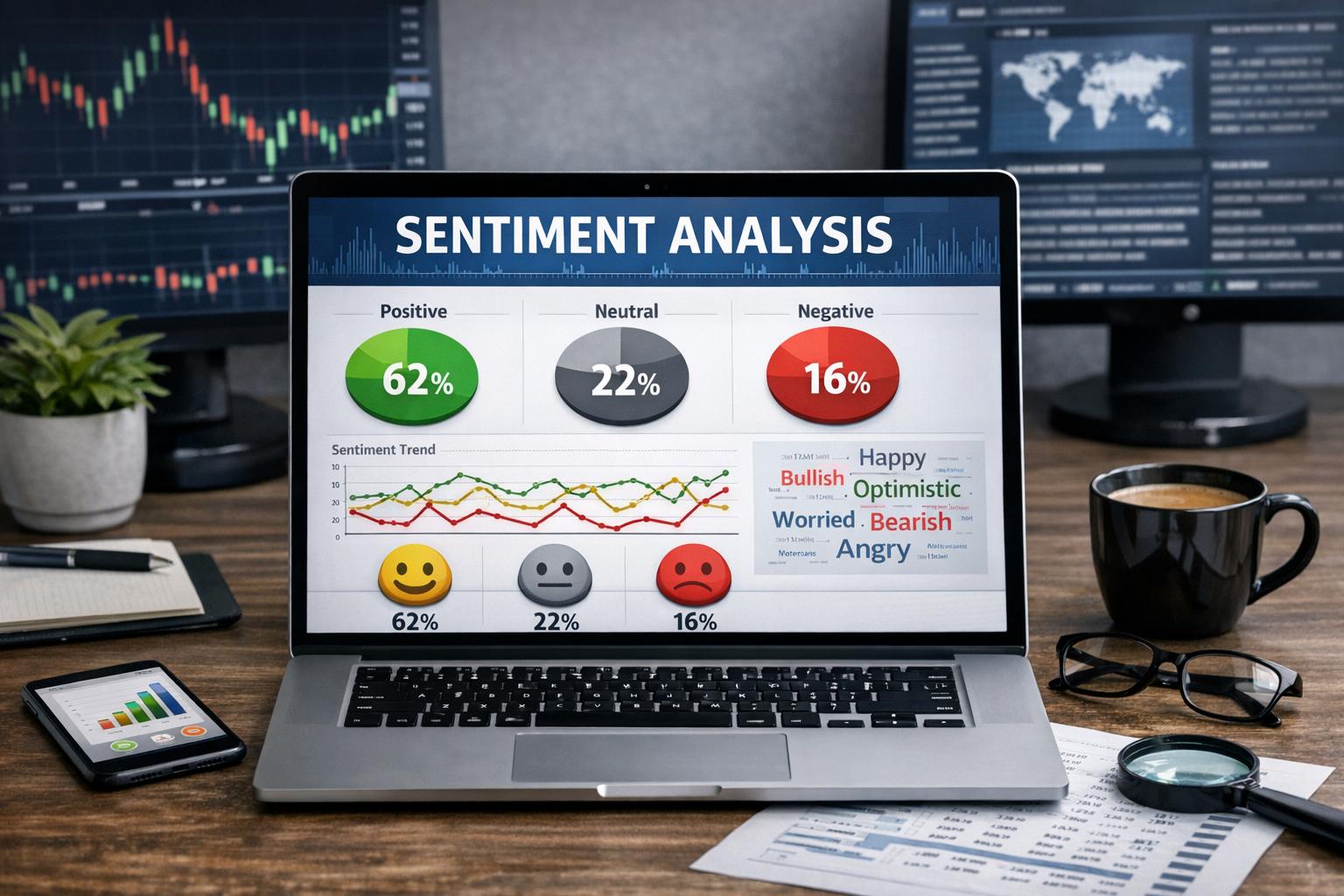
Most investors don’t lack opinions—they lack consistent signals. When you try to turn news, earnings calls, and market chatter into a usable forecast, you run into a common wall: everyone’s sentiment score feels different, and nobody can explain why it differs. Building your own sentiment analysis software helps you control the pipeline, test assumptions, and adapt the model to the words traders actually use.
This article walks through how to build a sentiment analysis system for finance-related text, with the practical engineering choices that matter when you want signals you can measure—not vibes you can screenshot.
What “sentiment analysis for trading” actually means
Sentiment analysis sounds like it should be simple: read text, output a positive/negative score. In trading, that interpretation breaks down fast. Financial text is full of structures that confuse generic sentiment models:
- Polarity isn’t the whole story: A company might sound “optimistic” while also admitting margin pressure.
- Negation matters: “Not expecting a decline” should differ from “expecting a decline.”
- Attribution matters: Management’s uncertainty doesn’t equal analyst pessimism.
- Time framing matters: “Will reduce costs next year” isn’t the same as “cut costs this quarter.”
So your software should produce more than one number. A workable approach is a sentiment feature set that can include:
– Overall sentiment score
– Uncertainty score (hedging, probability language)
– Risk tone score (words tied to risk, impairment, downgrades)
– Surprise/contrast signals (differences between guidance and prior statements)
– Domain-specific polarity (e.g., “guidance reiterated” versus “guidance revised down”)
The exact features depend on what you trade, but the pattern stays: turn text into structured data you can test against returns, volatility, spreads, or event outcomes.
Deciding your scope: what text will you process
Before you train anything, pick your data sources. This is where many projects quietly die, because “finance text” can mean several very different formats.
Common inputs
- News headlines and articles (often noisy, sometimes syndicated)
- Earnings call transcripts (long, structured, rich with forward-looking language)
- Press releases (management voice tends to be consistent)
- Analyst notes (strong subjectivity, heavy on comparative language)
- Social posts (high amplitude, high junk ratio)
For an initial system, earnings calls and press releases are usually friendlier than social media. They still have messy language, but at least the grammar carries intent instead of just noise.
Granularity: document, sentence, or section
If you score only whole documents, you’ll hide the useful bits. In earnings calls, for example, the risk discussion might be only a few paragraphs, but it can be what the market reacts to.
A moderate compromise is to segment text into:
– Sentences (for accurate sentiment mechanics)
– Speaker sections (management vs Q&A)
– Time-related segments (guidance vs past performance)
– Topic segments (costs, demand, supply chain)
You don’t need perfect topic modeling on day one; you need consistent segmentation so your evaluation stays meaningful.
Core architecture: from raw text to numeric features
Think of the system as a pipeline. Each stage should be testable on its own, because debugging sentiment models is like chasing a gremlin: it can be anywhere, and it only appears when you stop looking.
1) Ingestion and normalization
Your ingestion layer should:
– Store raw text exactly (so you can reproduce results)
– Keep metadata: timestamp, source, ticker/company mapping, and document type
– Normalize basic formatting (remove weird whitespace, fix encoding issues)
– Decide whether you keep or remove boilerplate (some press release templates skew sentiment)
If you trade across tickers, add a mapping table early. “Apple Inc” vs “AAPL” vs “Apple” will otherwise become a recurring headache.
2) Text cleaning (careful, not destructive)
You usually want to remove only things that add noise without meaning:
– HTML tags
– Excess line breaks
– Duplicate whitespace
Be cautious with removing “. . .” ellipses or stage directions in transcripts. Those often signal uncertainty or disagreement.
3) Segmentation
Segmentation determines how you attribute sentiment. Sentence splitting sounds easy until you hit abbreviations, transcripts, and inconsistent punctuation.
Rules of thumb:
– Keep the original sentence boundaries (store the preprocessed text and the sentence list)
– Use a model-based sentence splitter if you have many transcript formats
– Keep punctuation if you rely on negation or contrast markers
4) Sentiment extraction model
There are two main approaches:
– Rule-based / lexicon-based sentiment
– Model-based sentiment using machine learning or large language models
You can also hybridize: lexicon signals plus a learned model for nuance.
5) Feature aggregation
Once you score sentences, you need to aggregate into document-level features:
– Mean sentiment (simple but often diluted)
– Weighted mean (e.g., emphasize guidance sections)
– Max/min sentiment (to capture extreme statements)
– Proportion of “negative” sentences
– Uncertainty ratio (uncertainty words count / total)
Aggregation choice should match your trading hypothesis. If your strategy is sensitive to “guidance tone,” then weight that part more.
6) Output schema and persistence
Store your results in a structured form. A practical schema includes:
– Document ID and ticker
– Sentence-level scores (optional but helpful for debugging)
– Aggregated feature set (required)
– Version info for the model and preprocessing rules
– Feature generation timestamp
Versioning matters because sentiment systems drift: models update, your cleaning rules evolve, and your trading logic changes. Without versioning, you can’t tell whether a performance change came from the model or the data.
Choose your sentiment method: lexicon, model, or hybrid
This is the point where projects often turn into opinion wars. You can avoid that by matching the method to your constraints: speed, labeling effort, and time-to-iteration.
Lexicon-based sentiment: fast to build, rough at nuance
A lexicon approach assigns sentiment by word or phrase weights. It’s good for:
– Baselines
– Rapid prototypes
– Domain-specific tuning (e.g., weights for “write-down,” “restructuring,” “guidance,” “outlook”)
It struggles with:
– Negation (“not inflating”)
– Context (“raise” can be positive or negative)
– Sarcasm (mostly irrelevant in formal documents, until it isn’t)
– Multiword effects (“cost inflation” vs “inflation reduction”)
You’ll likely want a tokenizer that preserves phrases. A plain bag-of-words lexicon will miss “risk elevated” style patterns.
A useful variation is to start with lexicon scores and then add “context features” like negation and uncertainty detection through patterns (hedging words, modal verbs).
Model-based sentiment: better nuance, more work to validate
Model-based sentiment uses:
– Supervised classifiers trained on labeled text
– Transformer models fine-tuned for your domain
If you don’t have labeled finance sentiment, you still have options:
– Fine-tune using weak labels from events (earnings beats/misses)
– Use existing sentiment models and calibrate them on your domain
– Use distillation to get speed in production
Be careful with “out-of-the-box” sentiment models. They were trained on general language. Finance has a different distribution of words and a different meaning for familiar phrases.
Hybrid approach: lexicon features + learned model
This is often a pragmatic win. For example:
– Lexicon provides interpretable signals (risk words, guidance tone)
– A learned model captures contextual interactions (negation, contrast)
– Final model outputs sentiment categories or a continuous “tone index”
A hybrid system also makes it easier to debug. If your model predicts a negative tone, you want to know whether it’s because of risk lexicon hits, uncertainty patterns, or context shifts.
Building a labeled dataset without going broke
If you plan to train or fine-tune a model, you need labels. Getting labels is the tax you pay for accuracy.
Three practical labeling strategies
- Event-based weak labels: Use earnings outcomes, guidance revisions, or abnormal returns around events. Map “beat” to higher positive tone, “miss” to lower tone (with caution).
- Human annotation on a sample: Label a manageable subset manually—then train on that slice.
- Rule-based labeling bootstrapping: Start with heuristics (guidance up/down keywords), then validate by sampling and correcting.
Weak labeling is good for training representation, but you must evaluate with human-verified samples. Otherwise you end up optimizing the model to predict your labeling heuristics—not sentiment that matters to markets.
What should your labels represent?
You’ll get better training if your labels match a trading-relevant construct. Options include:
– Polarity: positive vs negative tone
– Uncertainty: hedging level
– Risk: risk admission and downside framing
– Guidance direction: upward revision vs downward revision
– Contrast: disagreement with prior guidance
You can label multiple dimensions, which tends to outperform a single “sentiment score” for finance text.
Annotation guidelines that prevent chaos
Even basic annotation needs rules:
– Handle negation consistently
– Decide how to treat mixed signals (some sentences positive, others negative)
– Specify whether sarcasm counts (usually not in corporate text)
– Define whether you label by management intent or surface language
A short annotation guide of 1–2 pages can save weeks of rework.
Model training and evaluation: the part people skip (and then complain)
Training sentiment software for finance isn’t just about training accuracy. Your evaluation needs to reflect what you will do with it in a trading pipeline.
Offline metrics are necessary, not sufficient
Use standard metrics:
– Accuracy/F1 for classification
– Regression error (MAE/RMSE) for continuous tone
– Calibration checks for probability outputs
But also include:
– Stability across time: does your model degrade when the language shifts?
– Stability across sources: does it work for transcripts as well as press releases?
– Robustness to length: does it systematically mis-score long documents?
Backtesting relevance checks
Even if your sentiment evaluation metrics look “good,” you still need to test whether the features predict something you care about. Typical targets:
– Post-news returns over different horizons (1h, 1d, 1w)
– Volatility change after announcements
– Bid-ask spread widening after negative tone
– Event-day abnormal returns for earnings-related documents
Important: avoid data leakage. If you build features using the same future window you later evaluate, you train a polite liar.
Train/test splits that make sense
Split by time. Don’t randomly shuffle. Do you remember that rule from every ML tutorial? It’s annoying because it’s true.
Use:
– Train on earlier dates
– Validate on a later slice
– Test on the last period
If you have many tickers, also consider:
– “Leave-one-sector-out” tests (to see if the model generalizes)
– “Leave-one-source-out” tests (press releases vs transcripts)
Feature engineering that beats “just use sentiment score”
A single sentiment score rarely does the heavy lifting. Your software becomes useful when sentiment interacts with structured features.
Uncertainty and hedging features
Finance language is full of “may,” “could,” “we expect,” “subject to,” and “we believe.” You can detect uncertainty with:
– Modal verb detection
– Hedging phrases
– Frequency of caution language
A common pattern: negative sentiment with high uncertainty might behave differently than negative sentiment with confident language.
Risk framing features
Risk vocabulary often signals market reaction:
– impairment
– write-down
– restructuring
– litigation
– supply constraint
– demand softness
Lexicon-based risk features can perform well because these phrases are semi-standard in corporate risk disclosures.
Negation and contrast detection
Negation breaks naive sentiment models. Add explicit detection for:
– “not,” “no,” “never”
– “didn’t,” “won’t,” “cannot”
– phrases like “without” (context-dependent)
– contrast markers: “however,” “but,” “while,” “although”
If your sentiment model outputs sentence scores but never learns negation rules, you’ll see recurring errors in “not bad” / “not expected to” type phrasing.
Time framing features
Distinguish:
– Past performance (“we saw growth”)
– Current state (“we are experiencing”)
– Future plan (“we will reduce”)
A trade based on near-term impact should weight current and near-future statements more than long-term plans.
Calibration: turning model scores into something tradable
Most sentiment detectors output a score-like number. Traders care about the relationship between score and outcome. Calibration is the step between model output and usable probability or index.
Scaling sentiment scores to probabilities
If your model outputs “probability of positive,” calibrate using:
– Isotonic regression
– Platt scaling
– Temperature scaling (common for deep models)
Test calibration on a time-based holdout set.
Creating a “tone index”
Instead of presenting a raw sentiment score, create a tone index with weights learned from historical predictive power.
Example conceptually:
– Tone = w1*(positive sentiment) – w2*(negative sentiment) – w3*(uncertainty) – w4*(risk)
– Add a ticker normalization term (some firms use consistently different wording patterns)
This creates a stable numeric signal you can compare across documents.
Software design for production: speed, reliability, and versioning
If you’re building sentiment analysis software for repeated use, you need it to run predictably. Nothing ruins a trading day like your model timing out because someone slipped a 400-page transcript into the queue.
Batch vs real-time processing
Decide your operational mode:
– Batch: run every hour or daily. Easier to manage, usually enough for many strategies.
– Near real-time: run as text arrives. More engineering and monitoring.
Start with batch if you can. It still forces you to handle data quality and evaluation.
Performance considerations
Transformer models can be slow. For production:
– Use smaller models first
– Cache repeated computations (e.g., same transcript segments)
– Precompute sentence embeddings if you do similarity features
– Use GPU inference only where it pays off
You can also deploy a two-stage system:
– Fast baseline model screens all documents
– Slow/high-accuracy model refines only documents above a threshold (e.g., high uncertainty or high risk language)
Monitoring and drift detection
Sentiment systems drift as language and sources shift. Monitor:
– Input distribution shifts (average length, token distribution)
– Sentiment score distribution shifts
– Calibration drift (if you output probabilities)
– Error rates on a rolling manually verified sample
A simple dashboard goes a long way. You don’t need rocket science; you need early warnings.
Reproducibility and model versioning
Store:
– Model version
– Preprocessing version
– Feature generation rules version
– Training dataset build ID
When performance changes, you can trace it. Without that, you end up guessing, and guessing is expensive.
Data privacy and compliance basics
Finance text often includes sensitive or licensing-restricted sources. At minimum:
– Respect usage rights for transcripts, articles, and paywalled data
– Don’t store more than you need
– If you use third-party APIs, review data handling policies
– Log access and ensure your environment has proper controls
This isn’t just legal housekeeping; it can affect whether you can deploy the system at all.
Hands-on: a practical development plan
If you want a sane path from zero to something useful, follow a staged build. Each stage produces an artifact you can evaluate.
Stage 1: Baseline that runs
– Choose one data source (e.g., press releases)
– Implement ingestion + segmentation
– Build a simple lexicon sentiment baseline
– Output document-level sentiment and uncertainty features
– Save outputs with metadata
Goal: a system that runs end-to-end and produces consistent outputs.
Stage 2: Add attribution and better aggregation
– Score sentences
– Aggregate using section weighting (guidance vs risk vs performance)
– Add negation detection and uncertainty phrase detection
– Validate on a small manually reviewed set to find obvious failures
Goal: improve interpretability and reduce “silly errors.”
Stage 3: Train or fine-tune a supervised model
– Create labels for sentiment dimensions you care about
– Train a classifier or regression model
– Evaluate on time-based holdouts
– Compare against baseline features
Goal: show measurable improvement.
Stage 4: Calibrate and connect to trading targets
– Calibrate outputs into probabilities or tone index
– Create predictive features for event windows
– Backtest and run sanity checks
Goal: make sure the model helps on the tasks that matter.
Stage 5: Production hardening
– Add monitoring and drift checks
– Implement batch scheduling or streaming inference
– Version models and preprocessing rules
– Add a manual review workflow for samples
Goal: reliability, not just accuracy.
Common failure modes (and what they look like)
Sentiment analysis for finance can fail in predictable ways. If you watch for these patterns, you’ll save time.
Failure mode: score looks fine but predictive power is weak
This happens when:
– sentiment score doesn’t match the market reaction mechanism
– your targets are wrong (e.g., using daily returns when the information hits intraday)
– the aggregation hides the relevant parts
Fix:
– Try sentence-level analysis with section weighting
– Align evaluation horizon to your hypothesis
– Validate that the documents you think matter are the ones driving predictions
Failure mode: model flips meaning after a source change
Corporate language style varies by source. A model trained mostly on transcripts might underperform on press releases.
Fix:
– Train with source metadata
– Evaluate leave-one-source-out
– Add source-specific calibration
Failure mode: negation errors drive noise
Negation is the classic. You’ll see false negatives or false positives around “not,” “no,” “without,” “cannot,” and contrast markers.
Fix:
– Add negation patterns and test them with a curated set
– Use sentence-level scoring and inspect negation-heavy examples
Failure mode: leakage sneaks in through labels
If labels are derived from event outcomes that overlap with features (directly or indirectly), your model can appear brilliant offline and collapse later.
Fix:
– Keep feature generation strictly in the past relative to labels
– Audit label creation logic and time windows
How to validate sentiment signals without fooling yourself
A useful validation stack looks like this:
1) Manual review of errors
Sample mispredictions and categorize why:
– wrong due to negation
– wrong due to mixed sentiment
– wrong due to unfamiliar domain jargon
– wrong due to long-range context
This tells you whether to fix text processing, labeling, or modeling.
2) Compare against simple baselines
Before you add complexity, compare to:
– term frequency of risk words
– uncertainty phrase counts
– lexicon sentiment alone
– guidance direction keywords
If your model can’t beat these baselines on the same evaluation framework, it’s not “innovation,” it’s just extra compute.
3) Correlation with other market signals
Sentiment features shouldn’t exist in a vacuum. You can check whether your tone index correlates with:
– implied volatility changes (carefully, with time alignment)
– abnormal volume
– spread changes
This isn’t proof of causality; it’s a sanity check that your signal is not random noise.
Building sentiment that traders can actually use
A sentiment score in a spreadsheet is fine for curiosity. A tool that informs decisions needs conversion into actions or at least into consistent thresholds.
Turning tone into decision rules
Common approaches:
– Threshold-based: enter when tone exceeds certain percentiles
– Ranking: rank tickers by tone and take top/bottom slices
– Regression: tone feeds into a model predicting future return or volatility
If you have transaction costs, thresholds depend on tradeability. A small edge that looks great in backtest can vanish after slippage.
Risk controls for text-driven strategies
Text signals can be erratic. Put basic controls in place:
– cap position sizes by uncertainty
– avoid trading on low-confidence documents
– require multiple documents or corroboration for extreme actions
Your sentiment system should provide confidence metrics or at least inputs you can use for risk sizing.
When to use an LLM and when not to
Large language models can produce sentiment-like outputs quickly, but you still need governance. The decision isn’t just “is it smart,” it’s “is it stable and auditable in your setting.”
Pros
– Better at context, negation, and multi-sentence interpretation
– Less labeling effort early on
– Can classify sentiment dimensions beyond polarity (uncertainty, risk framing)
Cons
– Output drift across API/model versions
– Harder to reproduce exactly
– Longer inference times
– You still need evaluation against your trading targets
If you use an LLM, treat it like a component in your system, not the whole system.
Practical LLM usage patterns
– Use LLM to generate weak labels for a training set, then train a smaller model for production
– Use LLM for sentence-level scoring only, then aggregate with your rules
– Use LLM for special cases (e.g., rare event announcements) while baseline handles the bulk
This way you get the best of both worlds: quality for tricky cases, speed for routine processing.
Example: turning earnings transcript text into a tone index
Let’s make the idea concrete without pretending we can predict earnings from one magic number.
Step 1: segment by speaker
In transcripts, you separate:
– Prepared remarks
– Q&A
– Analyst questions (optional, but useful)
Management language tends to be more stable, so it can drive your “stance” features.
Step 2: detect uncertainty phrases
Count modal verbs and hedging patterns:
– “we expect” vs “we may”
– “subject to” clauses
– “we believe” statements (often confident, sometimes not)
This yields an uncertainty score.
Step 3: score sentiment with a domain lexicon
Apply weighted words/phrases for:
– risk admission terms
– cost/downside terms
– guidance direction language
Negation detection adjusts polarity.
Step 4: aggregate into document-level features
Instead of averaging everything, weight:
– forward-looking guidance segments more than retrospective performance
– prepared remarks more than analyst questions
– risk sections with higher weight if your strategy trades risk tone
Step 5: calibrate into a tone index
Combine features into a tone index and normalize per ticker or sector baseline.
Now you have a signal you can compare across time. And when it misfires, you can inspect which sentence groups caused it.
Maintenance: the part that keeps your software alive
Even a good sentiment model becomes stale. Maintenance is what separates a weekend project from something you can actually depend on.
Text pipeline changes
Sources update formatting. Your transcript format might change subtly, breaking sentence splitting. Build tests:
– run a known sample set through preprocessing every day
– check token counts, average sentence length, and missing fields
Model updates
If you fine-tune periodically:
– keep an evaluation gate
– compare performance to the previous version using time-based tests
– don’t roll forward just because accuracy improved on the latest split
Human review loop
Maintain a small workflow:
– sample recent documents
– compare predicted sentiment dimensions to human judgment
– record error categories
This gives you training targets for continuous improvement and makes the system less of a black box.
What you should measure if you want to trust the output
Sentiment software should come with metrics that align to trust, not just model performance. If you don’t measure these, you’ll only learn the model is failing when trading results say so.
Track:
– distribution shifts in scores
– proportion of documents with low confidence
– stability across tickers and sources
– error rate on a rolling labeled sample
– correlation of tone index to your chosen market outcome windows
You’re building an instrument. Instruments need calibration.
Where people usually get stuck (and a straightforward way through)
Stuck: “We can’t label enough data”
Solution:
– Start with weak labeling and manual validation on a smaller subset
– Train a representation model (even modestly) and then refine
– Use a hybrid approach with lexicon features while you build labeled data
Stuck: “The sentiment score doesn’t predict returns”
Solution:
– Re-check evaluation alignment (event window, time zone, trading hours)
– Split by document type (transcripts vs headlines)
– Weight guidance and risk sections differently
– Add uncertainty and risk features rather than only polarity
Stuck: “Model is accurate offline but bad in backtest”
Solution:
– Audit leakage and label creation time windows
– Evaluate on the same time granularity you trade
– Check if your pipeline changes between training and inference
Building your own sentiment software: what “done” looks like
Don’t aim for perfection. Aim for a system that:
– runs reliably on your target sources
– produces repeatable outputs with versioning
– has evaluation that matches your trading objective
– can be debugged when it misbehaves
If you can inspect sentence-level and section-level contributions to your tone index, you’re in good shape. If it’s just one opaque score with no audit trail, you’ll eventually treat it like a lucky charm. Lucky charms are fine until they aren’t.
Next steps: pick a starting point and iterate
If your goal is to build sentiment analysis software you can actually use, start small:
– one data source
– one or two sentiment dimensions (polarity + uncertainty)
– one aggregation strategy
– one evaluation target (event-day abnormal return, or volatility change)
From there, expand. Add risk framing features. Add calibration. Add better segmentation. But keep each change measurable.
Because the real win isn’t “sentiment scores.” It’s repeatable signals you can test, explain, and improve—without turning your project into a never-ending argument about what the model “should” feel.