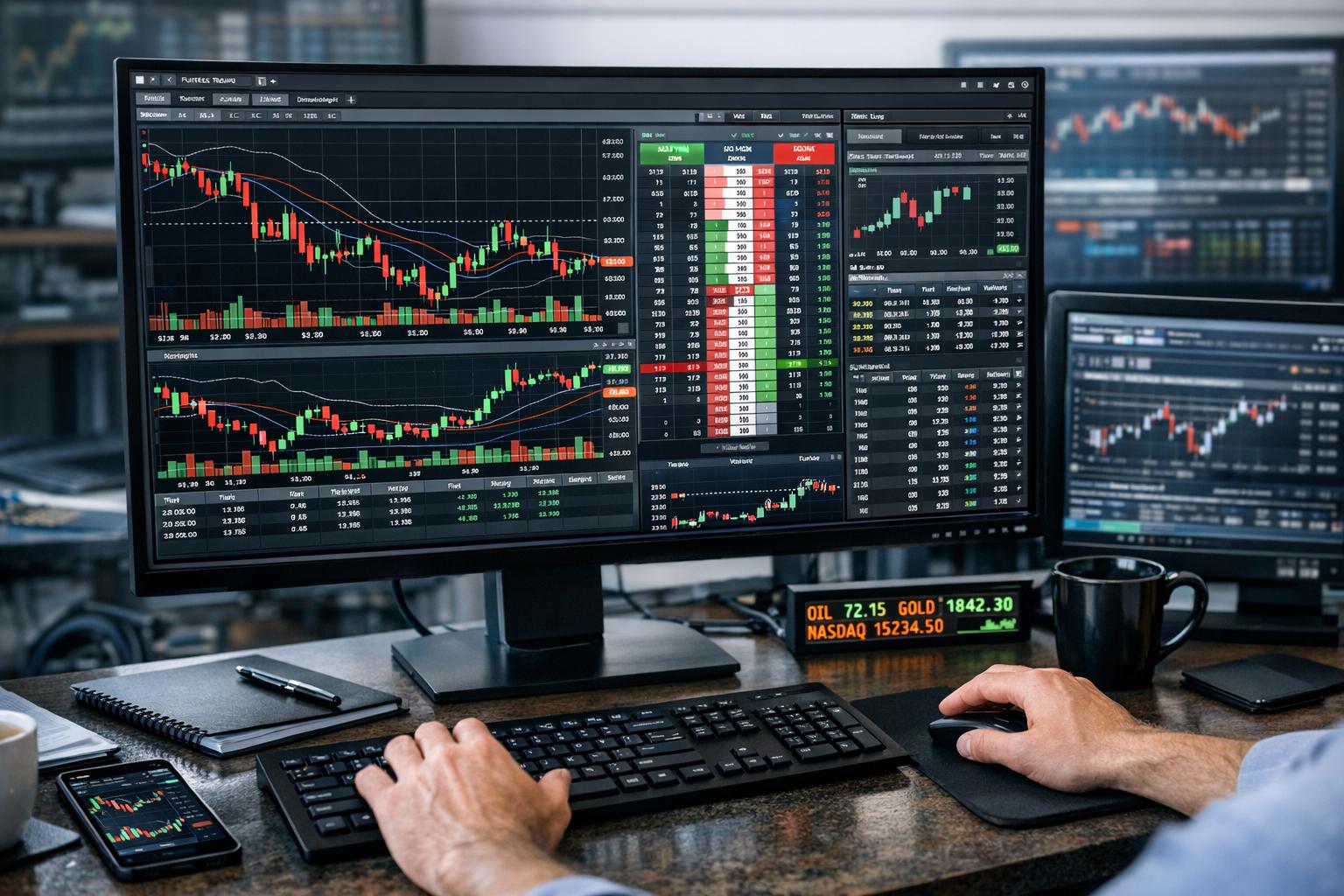
You don’t need a computer science degree to build futures trading software, but you do need discipline. Futures trading is unforgiving: markets move fast, data has quirks, and small mistakes propagate into real money problems. So this guide treats your project like a software build first and a trading system second—because if the software can’t be trusted, the strategy doesn’t stand a chance.
Below I’ll explain what “making your own futures trading software” actually involves, how to structure it, what components you need, where people usually get it wrong, and how to move from a hobby prototype to something you can test seriously. No magic; just engineering.
What “futures trading software” usually means
Before writing a line of code, it helps to pin down what you’re building. People use the phrase broadly, but most systems fall into a few categories.
1) Execution-only (trade copier / signal relay)
You receive signals from elsewhere—maybe a spreadsheet, a web app, or another model—and your software handles: order placement, position tracking, cancellations, and risk checks. This is often the fastest path to a working system because strategy logic sits outside.
2) Strategy + execution (algorithmic trading)
Your software generates signals based on market data, then places orders according to rules. This is the “full stack” version: data ingestion, feature calculation, signal generation, order management, and risk controls.
3) Research platform + backtesting + paper trading
You’re not trying to trade live immediately. Instead, your software focuses on reproducible backtests, walk-forward testing, and paper execution that mimics the real trading environment. A lot of serious builders spend more time here than they’d like to admit.
4) Monitoring and auditing (the grown-up layer)
Even if your trading logic is simple, you still need reporting: fills, slippage estimates, positions, logs you can read later without crying, and alerts for “something’s wrong.” Many “trading bots” fail because monitoring is an afterthought.
Legal and practical boundaries you should respect
This isn’t legal advice, but it’s practical boundary-setting. Futures trading typically means you’ll be working through a broker or exchange interface (often via a trading API). That API will come with constraints: allowed order types, rate limits, session behavior, and requirements for risk controls.
Also, “making software” doesn’t exempt you from responsibility. If you deploy a program that sends orders incorrectly, your broker won’t care that it’s your first week on the job.
Practical rule: implement risk limits in your code and also configure broker-side limits. Redundancy beats hope.
Core components of futures trading software
A futures trading system generally looks like a pipeline with feedback loops. Orders flow out; fills and market data flow back; your internal state must stay consistent.
Market data layer
You need a dependable source of futures prices. Depending on your setup, you may use:
– Real-time quotes (bid/ask or last)
– Full depth (order book) if your strategy needs it
– Trade prints or aggregated bars (OHLCV)
– Contract metadata (tick size, multiplier, trading hours)
Your software should handle messy reality:
– delayed feeds
– missing updates
– out-of-order timestamps
– session changes (rollovers, halts)
If you’re backtesting, you still need the “data plumbing.” Backtests quietly break when data formats don’t match live assumptions.
Strategy and signal generation
This part can be as simple as moving averages or as complex as models. But there’s a big difference between “strategy code” and “strategy engine.”
A strategy engine:
– consumes normalized market data
– maintains any required state (rolling windows, indicators)
– outputs desired actions (target position, signals, order intents)
– stays testable and deterministic to the extent possible
Many failures come from mixing strategy logic with execution logic. Keep them separate so you can change one without breaking the other.
Order management system (OMS)
The OMS is where most of the complexity lives. Futures trading isn’t just “send market order and hope.” You must handle:
– new orders
– partial fills
– cancels/replace
– rejections
– time-in-force behavior
– position reconciliation
An OMS typically maintains:
– an internal order book (your view of what you sent)
– a mapping between broker order IDs and your client-side order IDs
– current working orders vs filled positions
Execution engine
This component decides how to turn a strategy output into broker actions. It deals with order types (limit, stop, stop-limit, market), pricing logic, and timing rules.
If your strategy outputs “buy,” the execution engine still needs to decide:
– limit price relative to bid/ask
– whether to chase price or wait
– what to do if you don’t get filled
– how long to keep a working order
Risk management
Risk management is not a checklist item. It’s a live system layer.
At minimum, you want:
– max position size per contract and per account
– max order size
– max number of open orders
– max daily loss and/or max drawdown limits
– price sanity checks (no placing orders at nonsense prices)
– cooldown rules if you hit rejections or repeated failures
Also consider margin and leverage. Futures margin systems can change based on volatility and broker settings. Your code should not be “margin optimistic.”
State, reconciliation, and persistence
You care about one thing more than people admit: can your system recover?
If your program restarts mid-session, it needs to:
– re-load last known state
– pull current positions from the broker
– re-download open orders
– reconcile discrepancies (for example, you thought an order was working but it’s been filled)
That requires persistent storage for logs, configuration, and often strategy state. For paper trading and research, it might be a database. For smaller projects, a careful file-based approach can work—until it can’t.
Choosing a development approach
You have two practical paths: start small and iterate, or build a framework first. Most builders do some of both.
Start with a thin vertical slice
A vertical slice is a small end-to-end workflow that works:
1) get market data
2) compute a simple signal
3) place an order
4) receive fills
5) update positions
6) log everything
Don’t start with indicator libraries, backtesting frameworks, and an elaborate OMS. Get one happy path running, then harden it.
Decide where your “truth” lives
You need a clear definition of what is the source of truth:
– Broker positions are usually truth for live trading
– Your internal state is truth for decisions
– Logs are truth for debugging
Your system should treat broker responses as authoritative and treat its own decisions as best-effort until confirmed by broker reports.
Programming language considerations
Pick a language you can maintain under pressure. Performance matters, but correctness matters more. Python is common for research and prototyping. C# and C++ show up in lower-latency setups. Java and Go can work too. Many real projects run a hybrid:
– Python for strategy research and feature calculations
– a lower-latency service in another language for execution/OMS
If you’re just starting, the simplest workable system beats the fastest one you never deploy.
Data engineering: the part everyone underestimates
Your strategy accuracy depends on the quality and alignment of your data and your execution assumptions.
Instrument and contract handling
Futures contracts roll. That means the symbol, month code, or instrument ID changes. Your system must:
– map continuous contracts to real tradable contracts (for backtests)
– handle roll schedules
– know tick size and contract multiplier for profit/loss calculations
If you ignore roll logic, your backtests will look clean while live results quietly misalign.
Time alignment and bar construction
If you use OHLCV bars, confirm:
– the timezone used by the data
– bar boundaries (e.g., exchange time vs local time)
– whether the last bar is incomplete in real-time
A common mistake: computing an indicator using a bar that hasn’t fully closed, then backtesting as if it had.
If your strategy trades on bar close, enforce that in both backtest and live logic.
Slippage assumptions for backtesting
Slippage isn’t optional. Even if you plan to use limit orders, you might not get filled. For backtests you need rules for:
– fill probability estimates
– order execution logic vs historical bid/ask
– spread handling
– event-based latency (at least an approximation)
If you only use mid-price in backtests, your live fills will look like they took a day off.
Latency and rate limits
Futures APIs often enforce rate limits. Your code must avoid:
– request storms
– synchronous polling loops that block processing
– reconnect loops with no backoff
A robust system uses async workflows (or threading with care) so market data processing doesn’t freeze while orders are being handled.
Backtesting and paper trading that don’t lie
Backtesting is where optimism goes to die. You can make any strategy look profitable with the right assumptions. Your goal is to reduce avoidable fantasy.
Backtest architecture basics
A sane backtest engine uses:
– the same strategy interface as live trading
– the same order sizing logic
– a realistic event loop (market updates trigger indicator updates and order decisions)
The backtest should simulate:
– when orders are placed (timestamp)
– whether they would have been eligible at that timestamp
– whether fills occur (based on price movement and order type rules)
– how partial fills affect subsequent decisions
At minimum, your backtest should produce:
– trade list with timestamps
– realized P&L and fees
– position timeline
If you can’t explain the output, it’s not ready.
Walk-forward testing
If you rely on a single training period and a single test period, you’ll overfit. Walk-forward testing mimics “keep learning but not cheating.”
The key idea:
– train on a window
– test on the next segment
– roll forward and repeat
For indicator-based strategies, you might not “train,” but you still have parameter selection. If you tune parameters on the same period you test, your results will look better than reality.
Paper trading as a final rehearsal
Paper trading is not the same as live trading, but it’s still valuable. Use it to test:
– order placement behavior
– cancel/replace logic
– state reconciliation after disconnects
– logging and monitoring
If paper trading shows frequent order rejections or desync, fix that now. Live markets aren’t interested in your learning curve.
Order types and what they imply for software
Futures brokers support various order behaviors. Your OMS must handle their semantics precisely.
Limit orders
Limit orders place a condition on price. Your software must handle:
– working order persistence
– price improvement checks (optional but helpful)
– partial fills
– time-in-force and expiration
– what happens if the market crosses your limit between updates
In backtests, define a fill rule. In live, rely on broker execution reports but still validate your assumptions.
Market orders
Market orders trade immediately but introduce slippage. If your strategy depends on exact prices, market orders will ruin your day. Even so, market orders can be fine for certain execution windows.
Your OMS still must handle:
– rejects due to limits
– connection latency (order might arrive late)
– partial fills
Stop and stop-limit orders
Stop orders depend on trigger prices. In code, you need to model:
– trigger condition (last, bid/ask, mark price—varies by exchange and broker)
– activation timing and order conversion behavior
– behavior during gaps
If you aren’t sure which price basis you’re using, verify with broker documentation and test in a paper environment.
State machines: making order handling reliable
If you want fewer nasty surprises, treat your system as a set of state machines. Particularly for orders and positions.
Order lifecycle states
Typical states include:
– created
– submitted
– acknowledged
– working
– partially filled
– filled
– canceled
– rejected
– expired
Your code should move between states based on broker messages. Don’t rely solely on your own timers.
Position lifecycle states
Positions also change through fills, not by your intent. Position management should:
– update from fills
– reconcile periodically with broker positions
– compute exposure metrics (not just raw quantity)
A strategy might want to “go long 1 contract.” But if you already have risk constraints or you’re partially filled, the execution plan needs to adapt.
Risk management that you can actually implement
You can write risk checks that are more useful than a long PDF.
Pre-trade checks
Before sending an order, validate:
– strategy intent doesn’t exceed position limits
– order size is within configured bounds
– price is within reasonable range based on latest market data
– market is in trading session for that contract
– notional and margin estimates are within broker-configured constraints (as available)
For practical trading software, even a simple price sanity rule saves you from the “unit conversion” bug that sends orders at 10,000x the intended price.
Post-trade and circuit breakers
After fills or rejections, check:
– daily P&L limits
– consecutive rejection counts
– order throttling behavior
– whether you’re stuck with many working orders
Circuit breakers don’t mean “shut down forever.” They should trigger a safe mode:
– stop new entries
– allow position reduction only
– require manual override
– or wait until a reset time
This depends on your trading style and your broker environment.
Exposure metrics for futures
For futures, what matters isn’t just contract quantity. You should compute:
– delta exposure (if options, but for futures it’s simpler: quantity times contract multiplier)
– notional exposure (price times multiplier times quantity)
– P&L in currency space
– contract-level exposure (per instrument)
Make sure fees and commissions are included. Without that, “profitable” strategies often fail in real life.
Monitoring, logging, and audit trails
If you don’t log, you’re negotiating with the universe. Logging isn’t glamorous, but it’s how you debug a bot that “worked yesterday.”
What to log
Log:
– configuration at startup (risk limits, symbol list, strategy parameters)
– market data snapshots used for decisions (or at least the computed indicator values)
– signals generated (what triggered the entry)
– orders sent (type, quantity, price, timestamp)
– broker responses (acknowledgements, partial fills, rejections)
– fills and resulting positions
– P&L and risk metrics after each fill
You don’t need to log every tick in detail. But you do need enough breadcrumbs to reconstruct decisions.
Metrics and dashboards
At minimum, you want numbers such as:
– current positions by contract
– open orders
– fill rate
– average slippage estimate (if calculable)
– daily P&L
– error and rejection counts
Even a simple terminal output or a local web page helps a lot during testing.
Testing beyond backtests
Backtests test the strategy against historical data. Software testing should also verify behavior under failure modes.
Unit tests for indicator and math code
Test:
– indicator calculations (rolling windows, smoothing)
– conversion between ticks and prices
– P&L formulas and multiplier logic
– data normalization
Math bugs are boring, but they’re expensive.
Integration tests for broker API interaction
Mock the broker API or use a sandbox environment. Validate:
– order lifecycle handling
– reconnection logic
– handling of duplicates and out-of-order messages
– time synchronization and timestamp parsing
A lot of trading APIs send messages that don’t perfectly fit your assumptions.
Simulation with “bad input” scenarios
Test how your system reacts to:
– missing market data updates
– stale prices
– delayed connection
– repeated order rejects
– sudden session close
– contract roll boundaries
A system that handles “oops” calmly is the one you can trust during real market weirdness.
System architecture patterns that work
You can structure the project in several ways. Here are patterns that tend to reduce chaos.
Event-driven architecture
Market data arrives as events, broker reports arrive as events, strategy processes events into decisions, and execution places orders. This reduces tight coupling and makes it easier to trace what happened.
Separation of concerns
Keep this separation:
– Data ingestion service
– Strategy module
– OMS / execution module
– Risk module
– Storage/logging module
Even if all of this lives in one repository at first, give each module a clear interface. It’ll save you later.
Configuration management
Trading software changes behavior frequently. Make configuration explicit:
– risk limits
– symbol lists
– order sizing rules
– session schedules
– paper vs live endpoints
Store configuration in version-controlled files, and keep the runtime config recorded in logs.
Implementation details that save time (and money)
These are the sorts of issues that show up in day-to-day building.
Numeric precision and rounding rules
Futures have tick sizes, and quantity values have allowed increments. Always round prices to tick size and quantities to allowed lot sizes.
If you ignore rounding, orders will be rejected by the broker, and then you’ll spend time blaming your strategy when it’s actually price formatting.
Timezone handling
Trading sessions and data timestamps depend on timezone. Pick one internal standard (usually UTC) and convert at the system boundaries. Don’t mix local time and exchange time in the same computations.
Reconnection logic with backoff
When the connection drops, your system should:
– stop sending new orders temporarily
– resubscribe to data feeds
– request current open orders and positions when possible
– reconcile state
Also implement exponential backoff to avoid making your connection worse. Yes, this happens.
Idempotency for order requests
Your code may retry requests in the face of timeouts. Make sure you don’t accidentally submit duplicate orders. Client-side order IDs help. Ensure the broker API supports idempotent operations or has matching mechanisms.
Costs, fees, and realistic performance evaluation
A strategy that outperforms gross might underperform net.
Commission and fees modeling
Include:
– per-contract commission
– exchange fees if provided
– slippage estimates
– funding or margin effects if relevant in your environment
If your broker provides fee schedules, use them in your backtests. If not, estimate but document it so you don’t mistake “estimated” for “known.”
Borrowing and margin considerations
For futures, classic borrowing isn’t relevant like it is for equities, but margin requirements and maintenance margin are. Make sure your position sizing logic assumes worst-case margin usage for your test horizon.
A common failure pattern: you size positions “as if” margin scales linearly and fixed, then live margin locks you out when volatility changes.
A practical build roadmap
If you want a steady path, follow stages. Each stage should produce working output, not just code progress.
Stage 1: Data + logging + simple strategy signals
Connect to your market data source. Store enough data to confirm correctness. Implement a trivial strategy (like “buy when price crosses above X”) but focus on:
– correct timestamps
– correct computed features
– consistent event flow
At this point you might not even trade—just validate that your decision inputs match reality.
Stage 2: Execution simulation (local) + paper trading
Implement order placement in paper mode. Use limit orders at known prices so you can reason about fills. Validate:
– order lifecycle tracking
– fill handling
– position updates
– cancellation behavior
You’ll discover quick bugs here, which is good. Better now than when the market decides to be spicy.
Stage 3: Real risk checks and reconciliation
Add:
– pre-trade checks
– circuit breakers
– forced reconciliation on program restart
– daily loss limits
Do stress tests: disconnect and reconnect, simulate stuck orders, and observe how the OMS behaves.
Stage 4: Improve execution quality
Execution improvements depend on your strategy. For many strategies, you’ll spend more time tuning order placement than indicator calculations. Consider:
– limit order strategies near bid/ask
– execution timing windows
– smarter cancel/replace logic
Keep one change per test cycle, otherwise you won’t know what helped.
Stage 5: Replace brittle parts with robust modules
As you learn, you’ll find sections of your code that are too coupled or too ad-hoc. Replace them with clearer modules:
– a tested OMS
– a reliable persistence layer
– a risk engine with explicit rules
– a monitoring layer with alerts
This stage feels like “side quests,” but it’s the difference between a demo and something you can trust.
Common failure modes (the ones that keep repeating)
If you want to avoid the same mistakes other builders made, pay attention to these.
Backtest/live mismatch
Differences in:
– bar construction timing
– spread and fill rules
– slippage handling
– session and roll assumptions
can completely invert results.
Fix by aligning data and execution assumptions as closely as possible. At minimum, document the mismatch so you know what to watch.
State drift between strategy and OMS
Sometimes the strategy thinks it has a position or expects an order to be working, but the OMS has a different view due to missed messages or restart behavior. Your system must reconcile frequently enough and upon events like reconnect.
Ignoring partial fills
If you assume a fill is all-or-nothing, you will eventually trade the wrong quantity. Futures can partially fill often enough to make this a serious bug, especially with limit order logic.
Overfitting the strategy to one dataset
Even if your engineering is perfect, you can build a strategy that’s just too tailored to the training period. This shows up as “it works in backtest and fails in live,” which is the classic tragedy.
The remedy is walk-forward testing and realistic assumptions.
Over-reliance on one data field
Some fields are not stable across sessions or providers (for example, last price vs mark vs bid/ask). If your strategy depends on a specific field, verify that it behaves consistently.
Security and operational hygiene
You’re sending orders, so treat your system like it has keys for a reason.
API credentials and secrets
Store credentials securely. Don’t hardcode them in source code. Use environment variables or a secrets manager if you have one.
Access control
Ensure only authorized users can modify configuration or trigger live trading. In practice, this can be as simple as file permissions and a small deployment process—still worth doing.
Version control and deployment discipline
Tag deployments and store the exact config used. If you change logic, keep a paper trail. It’s not romance, it’s debugging.
Example: a minimal architecture you can actually map to code
You’ll likely implement something like this in early versions.
Event loop skeleton
Your system runs with an event loop that consumes events:
– market data update
– broker order update
– fill
– timer event (for periodic risk checks)
– configuration reload (optional)
Each event triggers:
– update internal state
– compute strategy actions if appropriate
– run risk checks
– send orders via OMS
Interfaces worth defining early
Define clear interfaces:
– IMarketDataProvider with methods to subscribe and fetch last known prices
– IStrategy with method like onMarketUpdate(…) returning desired target or signals
– IRiskEngine with method validateOrder(orderIntent, currentState)
– IExecutionEngine that turns validated intents into broker orders
– IOms that receives broker updates and maintains order lifecycle and positions
Even if you implement them crudely first, the interfaces keep you from tangled code.
Making it profitable on purpose: realism about strategy vs software
A reasonable expectation: building “futures trading software” mostly improves reliability. It doesn’t magically make a bad strategy good. If your strategy has an edge, good software reduces the damage from execution and operational mistakes.
The strongest engineering choices usually look boring:
– consistent time handling
– clean event flow
– accurate order/fill tracking
– careful risk limits
– realistic backtesting assumptions
If you get those right, you get a system you can evaluate. If you get them wrong, you get a system that just tells a confident story with incorrect data.
Rollovers, contract selection, and what to do if your favorite contract stops behaving
Futures markets are not static instruments. Liquidity changes, spreads widen, and behavior differs across months.
Your software should support:
– a contract universe (multiple months)
– roll schedules
– selection rules (most liquid month, or nearest active contract)
– a mechanism to stop trading a contract if data or liquidity becomes unreliable
If your system trades a contract that suddenly goes thin, you’ll feel it in fills and slippage. Better to have a rule than to watch it happen on a Friday evening.
Paper-to-live checklist you can follow without superstition
When you transition to live trading, focus on behavior, not vibe.
Verify:
– order lifecycle handling works under partial fills
– cancellations behave as expected
– restart/reconnect doesn’t duplicate orders
– risk checks block orders during session close or stale data
– P&L calculations match broker statements (at least within expected rounding and fee differences)
If any of these are shaky, fix them while you still have the safety net.
What to do with success: scaling beyond a single strategy
Once you have one strategy working robustly, it’s tempting to add more. That can work, but software needs a tenancy model.
Scaling usually means:
– you need a position and risk aggregation layer across strategies
– you need per-strategy namespaces for signals and order intents
– you need conflict resolution when two strategies want opposite trades
A clean approach: strategies output intents, risk and an orchestrator decide what orders can be executed given total constraints.
Common feature requests (and whether you actually need them)
People often ask for:
– a web UI
– a fancy charting module
– a reinforcement learning engine
– a “risk dashboard with AI explanations”
Most of these are fine later. Early on, the highest ROI features are:
– reliable order management
– accurate state reconciliation
– strong logging
– basic monitoring and alerts
– controlled backtesting/paper trading pipelines
A beautiful UI won’t prevent duplicate orders. It might prevent you from noticing them, though, which is not always helpful.
Implementation notes on fees, tick size, and profit calculation
Profit calculation in futures can be a source of quiet errors.
Contract multiplier and tick size
Ensure:
– P&L uses correct multiplier
– price rounding uses correct tick size
– fees are applied per fill, per contract, and per side, as per your fee schedule
If you compute P&L with rounding inconsistencies, you’ll misread whether a strategy is actually working.
Realized vs unrealized P&L
Your system should separate:
– realized P&L from closed positions / fills
– unrealized P&L from current mark price (if you show it)
When you compare to broker reports, use the same basis (last, bid/ask, or mark).
Performance considerations: where speed matters and where it doesn’t
Yes, speed matters in some strategies. But most developers start by wasting effort on latency. Your first goal is correctness.
Speed matters most if:
– you rely on tick-by-tick order book signals
– you place and adjust orders rapidly
– you compete with other participants
Speed matters less if:
– you trade on slower intervals (bar close)
– your execution logic is simple
– your system’s job is to be consistent rather than fastest
Prioritize:
– correct state updates
– robust event handling
– predictable computation pipelines
Only then optimize hot paths.
How to keep your software maintainable
Trading code tends to accumulate “temporary hacks.” The best time to stop that is early.
Practical maintainability rules:
– version your configuration
– keep modules small and interfaces stable
– write tests for math and order handling
– use a consistent logging format
– document assumptions (especially fill rules and backtest assumptions)
If you can’t explain what your system assumes about fills, you can’t evaluate it properly.
Summary: building futures software is mostly engineering discipline
Making your own futures trading software comes down to architecting a reliable loop: ingest data, compute signals, send orders, receive fills, update state, enforce risk, and log everything so you can learn. The strategy is the tempting part, but the execution and state management are what decide whether your results are real.
The fastest way to progress is a thin working slice, followed by paper trading, then robust risk checks and reconciliation. After that, improve execution quality and add monitoring. Keep your backtests aligned with live assumptions, and you’ll spend less time arguing with your own software and more time learning from good, measurable outcomes.