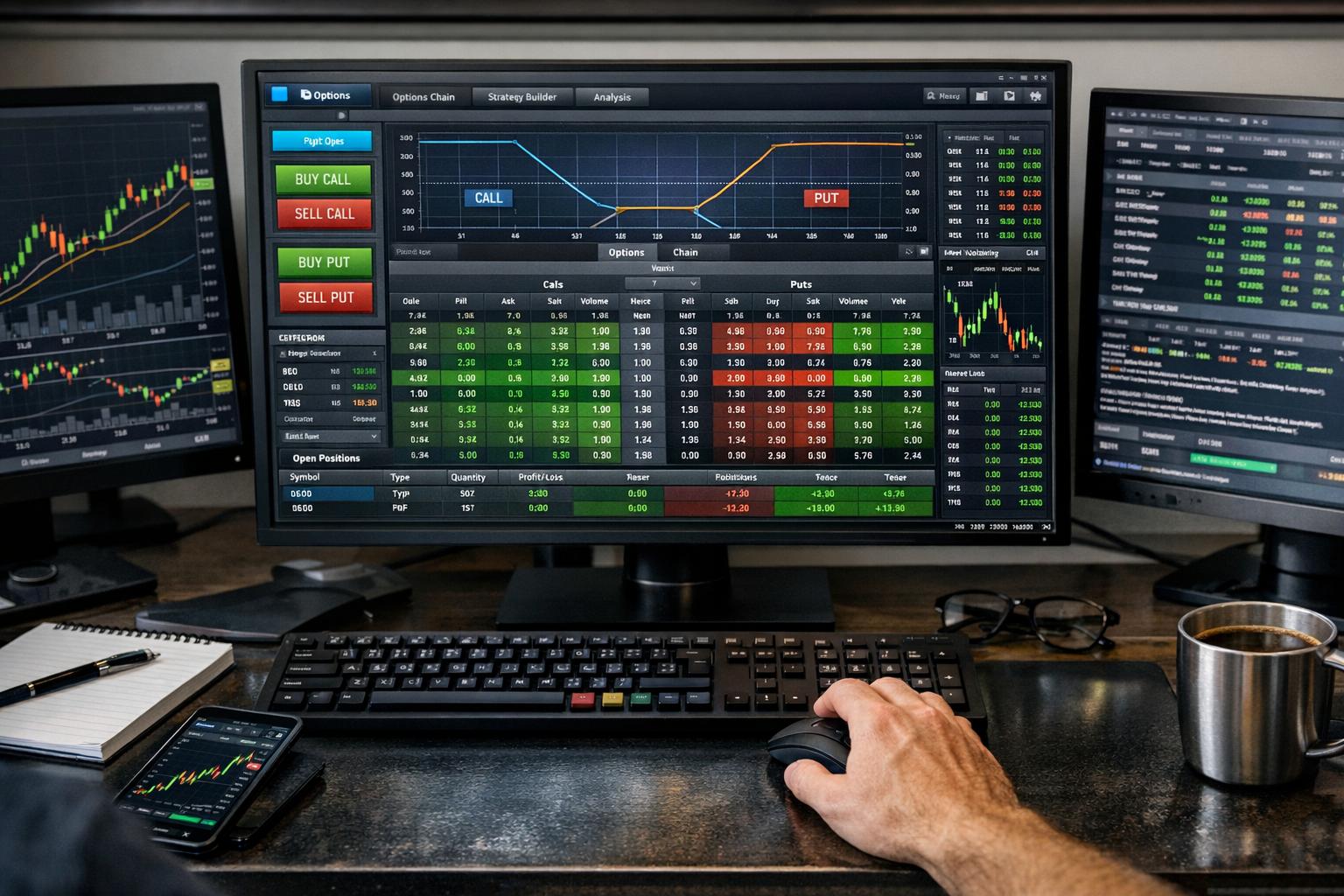
Introduction: what it really means to “build your own options trading software”
Making your own options trading software sounds straightforward until you compare it with what a trading desk actually needs: reliable market data, strict order handling, risk controls that do not flinch, and enough logging to explain what happened after something goes sideways. Options trading adds its own fun—different instruments, expiries, strikes, greeks, greeks everywhere, and a market data layer that can be surprisingly messy.
This article walks through what to build, what to avoid, and how to structure a system that can place and manage options orders in a realistic way. I’ll keep the tone practical: fewer buzzwords, more “here’s how you’d implement it,” including where people usually cut corners and then pay for it later.
Define the scope before writing any code
The biggest mistake in “build your own trading software” projects is unclear scope. Options can mean anything from a research tool that simulates strategies to a live broker-connected system that places and manages orders with real money. Those are very different projects.
Choose your operating mode
Most projects fall into one of these modes:
- Paper trading / backtesting: No live orders. You replay historical market data and evaluate outcomes.
- Signal generation: You compute trades/alerts, but a human or separate system executes orders.
- Execution system: Your software sends orders to a broker and manages them through the lifecycle.
If you’re aiming for live execution, plan for “boring reliability” rather than “cool strategy demos.” A system that misses fills or mishandles partial executions can lose money even when the strategy logic is sound.
Pick the instruments and markets
Options software for equity options on an exchange is not identical to options on futures or crypto derivatives. Even within equity options, you’ll run into:
- Multiple expiries and strikes
- Differing contract specifications (multiplier, tick size)
- Possible symbol formatting differences across data vendors and brokers
- Corporate actions and contract changes
Decide early which underlyings and contract formats you support, and build the rest as incremental additions instead of a giant “support everything” effort.
Core components of an options trading system
Regardless of language or broker, most robust trading software contains the same functional blocks. Think of it like a kitchen: you can have fancy plating, but you still need a heat source, a timer, a way to store ingredients, and a rule for what happens when the stove goes wrong.
Market data ingestion and normalization
Options trading depends on consistent data. You’ll usually pull multiple stream types:
- Quotes (bid/ask)
- Trades (last price prints)
- Greeks (sometimes from vendor; often you compute)
- Underlying price for reference and implied volatility calculations
The practical issue: each data provider and broker delivers symbols, timestamps, and order-book formats differently. Your software needs a normalization layer that maps vendor/broker payloads into your internal contract model.
Contract & instrument model
You’ll want an internal representation of an Option Contract with fields like:
- Underlying symbol
- Expiry date
- Strike price
- Call/Put
- Exchange/venue (or routing info)
- Contract identifier (an ID stable across your system)
- Multiplier (for P&L and position sizing)
Even if you start with “just one exchange,” treat this as a first-class system object. Your later features—spreads, roll logic, position aggregation—depend on clean identifiers more than you’d like.
Strategy engine separate from execution
Your strategy logic should not be tangled with order placement. In practice, you separate:
- Signal generation (decide what to do)
- Order construction (translate a decision into how to place orders)
- Execution lifecycle (track fills, handle cancels, update positions)
This keeps you from rewriting everything when you change order types or add risk constraints.
Risk management, position tracking, and limits
Options risk is not just volatility; it’s also leverage via premium, assignment risk, and the way spread positions behave around greeks changes.
A minimal risk layer should at least track:
- Net position per contract and per underlying
- Exposure by strategy (e.g., long calls, short puts, spreads)
- Cash reserve / buying power assumptions
- Max order size and max number of open orders
- Time-based rules (close-only near expiration, trading windows, etc.)
You also need a “do nothing” failsafe. If data feed drops, your system should stop trading rather than guessing.
Order management system (OMS)
The OMS is where many hobby projects collapse. An OMS must handle the entire order lifecycle:
- Submit order
- Receive acknowledgements
- Track partial fills
- Cancel/replace where appropriate
- Reconcile order state on reconnect
Because brokers can behave differently under load, you treat order events as ground truth. If your system’s internal order state drifts from the broker’s state, you can end up doubling an intended position.
P&L, fills, and audit logs
For options, P&L is sensitive to contract multiplier, commissions, and assignment events. You should build:
- Fill recorder (raw executions)
- Position ledger (cost basis assumptions clearly defined)
- Realized/unrealized P&L calculation
- Comprehensive logs linking strategy decisions to orders and fills
If you ever need to debug a bad week, the audit trail is what saves you. Without it, you’ll be doing detective work with spreadsheets and bad memories.
Data you need for options: more than prices
Options pricing information is more than the option’s last trade. For trading, you need consistency across time, accurate contract info, and a reasonable view of implied volatility and greeks (whether vendor-provided or computed).
Option quotes and spreads
Many beginner systems look at the last price only. That’s fine for research. For execution, you care about bid/ask and depth where available. Even if you don’t use order book depth, you must model:
- Bid/ask spread (transaction cost proxy)
- Fast moves (latency and stale quotes)
- Back-and-forth updates (avoid placing orders using outdated data)
Implied volatility and greeks
You have two routes: use vendor greeks or compute them. If you compute, you need an options pricing model. People often start with Black–Scholes. For liquid equity options, it’s commonly used as an approximation.
However, the real world adds friction:
- Dividend yield assumptions (or use risk-free rate only and accept approximation)
- Volatility smile (BS uses one vol per option; market quotes imply a surface)
- Discrete cash dividends and rate changes
For a first version, you can compute greeks using mid-price and a volatility estimate. Just document it. Future-you will want exact assumptions when results don’t match your notebook.
Architectural choices: monolith vs services
When you’re “making your own software,” architecture becomes part of the product. You don’t want six microservices and a Kubernetes cluster for a parser and a strategy, but you also don’t want one giant program that can’t restart safely.
Recommended layout for a first serious system
A common practical choice is modular monolith with clear boundaries, or a small set of processes:
- Market data process (connects to vendor/broker; normalizes data)
- Strategy process (reads normalized data; produces desired actions)
- Execution/OMS process (places orders, tracks fills)
- Storage process (writes trades, quotes, logs, position events)
This keeps failures contained and testing manageable. You can run strategy without live trading by swapping a data feed source.
Why fault tolerance matters more than fancy patterns
Trading systems spend more time handling reconnections, missing messages, and state recovery than they do running strategy calculations. So your architecture should include:
- State snapshots
- Reconciliation on startup (compare local view vs broker)
- Idempotency for order placement (avoid resubmitting duplicates)
“It compiles” is not the same thing as “it survives a dropped websocket.”
Broker integration: the part no one wants to think about
Every broker has its own API quirks, symbol conventions, and order semantics. When people build new options software, they often choose their broker integration first. That’s usually backwards. Better: define your internal contract and order model, then adapt the broker.
Order types and what they mean in options
Common order types include:
- Limit orders (price-controlled)
- Market orders (speed-controlled)
- Stop orders (trigger-based)
- Stop-limit or market-if-touched variations
Options add considerations like:
- Wide bid/ask spreads in illiquid strikes
- Assignment/expiration handling for short positions
- Spread orders (what the broker supports)
Your software should treat order intent separately from order mechanics. For example, a “buy 1 call” is intent. The limit price selection and time-in-force are mechanics.
Time-in-force and trading hours logic
If you trade near expiration, your system must handle trading sessions and expiration cutoffs. Many brokers reject or modify orders outside supported times. Build explicit session rules for:
- Regular trading hours
- Pre-market and after-hours (if supported)
- Order expiry rules (DAY vs GTC vs custom cancel)
Reconciliation: the simplest way to avoid the “phantom position” problem
When your system restarts, it must reconcile:
- Open orders (from broker)
- Existing positions (from broker)
- Partial fills and remaining quantities
If you don’t, the system may think you’re flat and open a second position. Phantom positions aren’t a myth; they’re a weekend project with a bad ending.
Building the strategy layer for options
Strategies range from “buy a call when X happens” to multi-leg structures managed tick-by-tick. Your system design should support the strategy type you actually plan to trade.
Single-leg strategies: the baseline
Start with one-leg trades to validate the full pipeline: data in, decision out, order placed, fills tracked, P&L computed.
A typical single-leg strategy may depend on features like:
- Underlying trend
- Option implied volatility changes
- Relative value (e.g., IV rank vs historical)
- Liquidity constraints (avoid wide spreads)
Even if you don’t go statistical, you need a clean way to filter instruments by liquidity and time to expiry.
Multi-leg strategies: spreads and risk control
Spreads (vertical, calendar, diagonal) and iron condors are popular for a reason: they limit some risks. But they introduce ordering complexity.
You must decide how to represent a strategy:
- Leg-level: you manage each contract as a separate order and track aggregate exposure
- Structure-level: you build a “spread object” that knows its legs, quantities, and net behavior
Most systems work best with structure-level intent and leg-level execution. That means your strategy decides “enter a bull call spread,” and the execution layer maps it into two orders (buy call A, sell call B) with lifecycle coordination.
Greeks-driven rebalancing (optional, but common)
Many options strategies rebalance based on delta or gamma. If you implement that, be careful:
- Frequent rebalancing increases trading costs and slippage
- Greeks computed from approximate models can drift from vendor greeks
- Rebalancing logic can create order churn (lots of cancels/replaces)
A reasonable first approach is to use greeks for entry selection, and rebalance only on meaningful thresholds (e.g., delta change beyond a band, not constant tick-by-tick nudges).
Risk management for options: a practical checklist
Risk management is not a separate “feature” you bolt on after the strategy wins a few trades. For options, it should shape what the strategy is allowed to do.
Define risk limits in a way you can enforce
You need limits that connect to how orders are placed. Examples:
- Max number of contracts per leg
- Max premium at risk (for long options)
- Max short exposure (for short options), including margin assumptions
- Max net delta per underlying, or per account
- Max gamma exposure (if you track it)
Important: decide whether your limits use raw contract counts, notional premium, or estimated greeks. Enforcement is easier with quantities and premium. Greeks-based enforcement needs consistent greeks computation.
Handling assignment and expiration
If you trade short options, you will eventually face assignment or expiration. Your system must handle contract changes around expiry. Common approaches include:
- Close positions before expiration (simpler to manage)
- Allow assignment and track resulting stock positions (harder, but doable)
- Use broker events to update positions and avoid assuming outcomes
For most DIY systems, closing before expiration is the least painful path. If you later want assignment, treat it like a separate feature set with its own testing.
Liquidity filters and “don’t trade junk” rules
Options markets vary a lot. A strike that looks cheap can be expensive once you account for spread and slippage. Implement liquidity checks such as:
- Minimum bid/ask quality (spread relative to mid)
- Minimum quote freshness (avoid stale markets)
- Minimum trade volume (if available)
This can prevent a strategy that performs well in backtests from quietly bleeding in real execution.
Order execution tactics: turning intent into outcomes
In execution, micro-decisions matter. The same strategy can underperform simply because you chose the wrong way to enter and exit.
Limit order behavior and price selection
If you place limit orders, you must decide the limit price rule. Common rules include:
- Use mid price
- Use bid (for buys) / ask (for sells) with a small improvement
- Use a minimum target: don’t pay worse than X ticks from mid
You also need a timeout/cancel policy. If your order doesn’t fill by a certain time, cancel and reconsider. This reduces the risk you’re stuck with stale quotes when volatility jumps.
Handling partial fills
Partial fills happen constantly in options. Your OMS must update:
- Remaining quantity
- Average fill price and execution record
- Position updates and risk counters
When you place multi-leg structures, partial fills become trickier: you might end up with an unbalanced spread for a period. If your strategy requires neutrality (e.g., max risk hedged), you need logic to coordinate legs—either by waiting, hedging the imbalance, or enforcing a synchronization window.
Slippage modeling for backtests
Backtests that ignore slippage and spreads can look like geniuses wrote them. Real trading punishes that. If you plan to use backtest results to guide live behavior, include plausible execution assumptions:
- Spread costs (use bid/ask)
- Queue effects if you simulate limit fills
- Latency delay between signal and execution
You don’t need perfect modeling. You do need enough realism that the system doesn’t “celebrate” trades it couldn’t execute.
Testing strategy: how to validate without burning cash
Testing a trading system is part engineering, part paranoia. You want repeatability and logs. You also want separation: strategy tests shouldn’t require a live broker connection.
Unit tests for logic that can’t be wrong
Write unit tests for:
- Contract parsing and normalization
- Greeks calculations (with known reference inputs)
- P&L math based on multipliers and fills
- Order quantity calculations and rounding rules
This prevents silent bugs like “we used the wrong multiplier,” which can turn a profitable strategy into an accounting tragedy.
Simulation tests with recorded market data
Record market data and replay it through your strategy and paper execution engine. Ensure you test:
- Event ordering correctness (timestamps and sequence)
- Quote staleness handling and timeouts
- Reconnection events (if your pipeline supports it)
Recorded data is not perfect, but it helps you evaluate logic consistency without the randomness of live markets.
Paper trading run alongside live market data
Before live execution, run paper trading with real-time data and broker order simulation (if supported). This tests your broker integration, order building, and OMS reconciliation without financial exposure.
Technology stack: pick what you can maintain
People get hung up on language. You can build a trading system in many languages. What matters more is ecosystem maturity, developer comfort, and library availability for market data and websockets.
Core requirements for your chosen stack
You need:
- Reliable networking (websocket / TCP / REST depending on provider)
- Concurrency or async support (market data is time-sensitive)
- Good time handling (timestamps, timezone consistency)
- Database or log storage that you can query later
- Testing frameworks
If your team is small (it usually is), choose a stack you can debug at 2 a.m. after something weird happens. “Efficient” matters less than “legible.”
Storage: avoid the “CSV museum”
For trading systems, you’ll accumulate data quickly. Store:
- Quotes and trades (optionally compressed; depending on use)
- Orders and fills as event logs
- Positions snapshots (for recovery)
- Strategy decisions (so you can reproduce what happened)
If you don’t store enough information, debugging becomes folklore.
Building an internal API: make components talk cleanly
Once you separate data ingestion, strategy, and execution, you need clean interfaces between components. A simple internal event model can save you from spaghetti communication.
Event model for the trading loop
A clean approach is to define message types like:
- QuoteUpdate / TradeUpdate for market data
- GreeksUpdate if you compute greeks as part of the pipeline
- Signal or DesiredAction from strategy
- OrderIntent that turns desired actions into order parameters
- OrderAck, OrderFill, OrderCancel from broker
Use timestamps consistently, and make sure each component logs the event ID it handles. That makes it much easier to trace causality: signal → order → fill.
State management and invariants
You need well-defined invariants, like:
- An order’s remaining quantity never goes negative
- Positions reflect sum of fills minus cancellations/expirations where applicable
- Risk limit checks happen before sending the order intent
If you enforce these invariants, you catch many bugs early.
Example: a minimal module design (conceptual, not language-specific)
Below is a conceptual layout for a first “execution-capable” system. The point is not the specific code, it’s the separation of responsibilities.
| Module | Inputs | Outputs | Main responsibility |
|---|---|---|---|
| MarketDataNormalizer | Vendor/broker payloads | Internal QuoteUpdate/TradeUpdate events | Map symbols, timestamps, update formats |
| ContractRegistry | Contract metadata sources | OptionContract objects | Maintain contract specs and multipliers |
| StrategyEngine | Normalized market data | DesiredAction / Signal objects | Decide what to do given current conditions |
| RiskManager | Desired actions + current positions | Approved/Rejected order intents | Enforce limits and fail safe rules |
| OMS | Approved order intents + broker events | Order state, fills, cancels | Send orders, track lifecycle, reconcile |
| AccountLedger | Fill events and corporate action events (if any) | Positions, P&L, audit trails | Compute realized/unrealized and keep history |
Implementation details that matter in options
Here are the kinds of practical details that tend to break trading software when nobody is looking.
Symbol mapping and contract identity
Options symbols are not treated consistently across systems. Your normalized internal contract ID should remain stable even if the vendor symbol format changes. Store a mapping from vendor contract identifiers to internal IDs.
Rounding, contract sizes, and minimum increments
Options prices and quantities follow exchange rules and broker constraints. A robust execution layer must:
- Ensure prices conform to tick increments (where relevant)
- Round order quantities to whole contracts
- Respect broker limits like max order size
This avoids order rejections that cause state drift under load.
Timestamp consistency and “stale data” policies
When market data arrives late or out of order—which it will—your strategy must decide what to trust. Implement freshness checks like:
- Reject quote updates older than X milliseconds
- Require underlying price updated within a time window
- Define a strategy “data readiness” barrier before trading
Without freshness logic, your software can trade based on outdated implied volatility or bid/ask quotes.
Operational concerns: monitoring and emergency stops
A trading system you can’t monitor is a system you can’t trust. You need operational tooling—simple dashboards or even a log-based system—so you can tell what it’s doing.
Metrics that are worth tracking
Basic metrics include:
- Order submission rate and cancel/replace rate
- Fill ratio and average slippage estimate
- Quote freshness and data drop counts
- Risk limit rejections count
- Latency between signal time and order ack/fill
You don’t need full observability like a bank. You do need to detect when the system stops behaving like itself.
Hard kill switch
Build an emergency stop that:
- Stops sending new orders
- Optionally cancels existing orders (configurable)
- Locks strategy trading until a manual reset
You want this switch to work even if your strategy engine crashes. In other words: not all parts of the system should depend on each other for safety.
Common failure modes (and how to design them out)
It’s easier to prevent bugs than to debug them after money is gone. Here are frequently observed failure modes in DIY trading software and their design-level fixes.
State drift between strategy, OMS, and ledger
This happens when your internal positions don’t match broker positions after reconnects or partial fills. Prevention strategies:
- Use broker data as ground truth for open orders and positions
- Reconcile on startup
- Record every event with an ID and link it across modules
Naive backtests overfitting without execution realism
Backtests often use end-of-bar prices and assume fills at mid or last. You end up with a strategy that looks good on paper and then behaves terribly in live markets. Mitigations:
- Use bid/ask or mid with spread-based costs
- Simulate limit fills with conservative rules
- Include quote staleness and latency assumptions
Order churn due to re-quoting too aggressively
If you cancel/replace orders on every tick, you might drown in churn. That can violate broker pacing limits and increase slippage. Mitigate by:
- Adding thresholds for reprice and resubmit
- Using minimum time between order modifications
- Tracking “one decision per state change” to avoid loops
Greeks inconsistency between vendor and your computed model
If your strategy uses greeks from one source but your risk uses greeks from another (or uses different inputs), your decisions may conflict with risk enforcement. Fix by:
- Choosing one set of greeks inputs
- Documenting your formula and input assumptions
- Ensuring both strategy and risk refer to the same computed fields
Security and compliance basics (the unsexy part that still matters)
Trading software usually handles API keys and broker credentials. A breach doesn’t just expose data; it can expose trades.
Credential handling
Use environment variables or secure secret storage. Never hardcode keys in source code. Rotate keys and follow broker security recommendations.
Access control and auditability
If multiple people can run the system, introduce access control around:
- Starting live execution
- Changing risk limits
- Modifying strategy configurations
And keep logs. You want a trace of who changed what and when.
How to grow from “demo” to “actually usable”
Most successful builds grow incrementally. Here’s a sensible progression that keeps risk low while you gain confidence.
Phase 1: paper trading with a single-leg strategy
Goal: validate ingestion, contract mapping, order intent creation, and fill tracking using a paper execution mode. Make P&L match what you expect from recorded fills.
Phase 2: execution with strict guardrails
Enable live paper or small-size live trading if available. Use tight risk limits: small max notional, limited instruments, and conservative timeouts. The point is execution correctness, not performance.
Phase 3: spread strategies and coordinated legs
Add multi-leg structures only after single-leg execution is stable. Coordinating multi-leg fills is where systems get weird, especially if one leg fills and another doesn’t.
Phase 4: advanced risk (greeks, volatility surface constraints)
Only after your basic accounting is correct should you add complex risk constraints. Complexity is cheap to write and expensive to debug.
Real-world use cases: why people build their own
Not everyone builds trading software because they want to be the next quant. Sometimes they build it because they can’t get what they need from existing tools.
Use case: a custom options scanner with execution
A trader might want to scan for options where implied volatility dislocates relative to a model and then execute a fixed spread. Existing scanners might stop at alerts; custom software handles the full pipeline from signal to order with specific liquidity checks.
Use case: robust spread management for fewer mistakes
Some strategies—like iron condors or iron butterflies—require consistent leg handling. Building your own OMS and ledger can reduce human error. The goal is fewer “fat-finger” outcomes, not magic profits.
Use case: research-quality evaluation with realistic costs
Others invest in their own system because they want backtests that reflect actual execution assumptions. You can then compare your results under different slippage models and avoid the classic “it only works on paper” trap.
Common questions people ask before they start
Should I build from scratch or use an existing framework?
If you have minimal time and want correctness quickly, using an established trading framework can help. But “frameworks” also hide behavior you must understand for debugging. A compromise is to use a robust broker integration and build the strategy/OMS logic around it.
What’s the best language for this?
Any general-purpose language can work if it supports concurrency and you can test properly. Choose based on your comfort and library ecosystem rather than what someone on the internet says is “the best.” If you can’t debug it, it doesn’t matter.
How do I know my system is ready for real trading?
Readiness means:
- Paper trading results align with your recorded-fill expectations
- Order lifecycle handling survives reconnect/restart tests
- Risk limits block trades you expect it to block
- Logs allow you to reconstruct exactly what happened
Performance metrics are secondary until accuracy and stability are proven.
Conclusion: the actual work is correctness, not cleverness
Making your own options trading software isn’t mostly about implementing a strategy formula. It’s about building a system that stays correct under pressure: messy market data, partial fills, reconnections, and the inevitable moment when you think “that can’t be right” and then discover it’s missing an audit event.
If you focus on the internal contract model, clean module boundaries, a reliable OMS with reconciliation, and risk controls that are enforced before orders go out, you end up with software you can trust. Then you can spend time on strategy rather than spending weekends chasing state drift. Which is nice—your calendar deserves better than that.