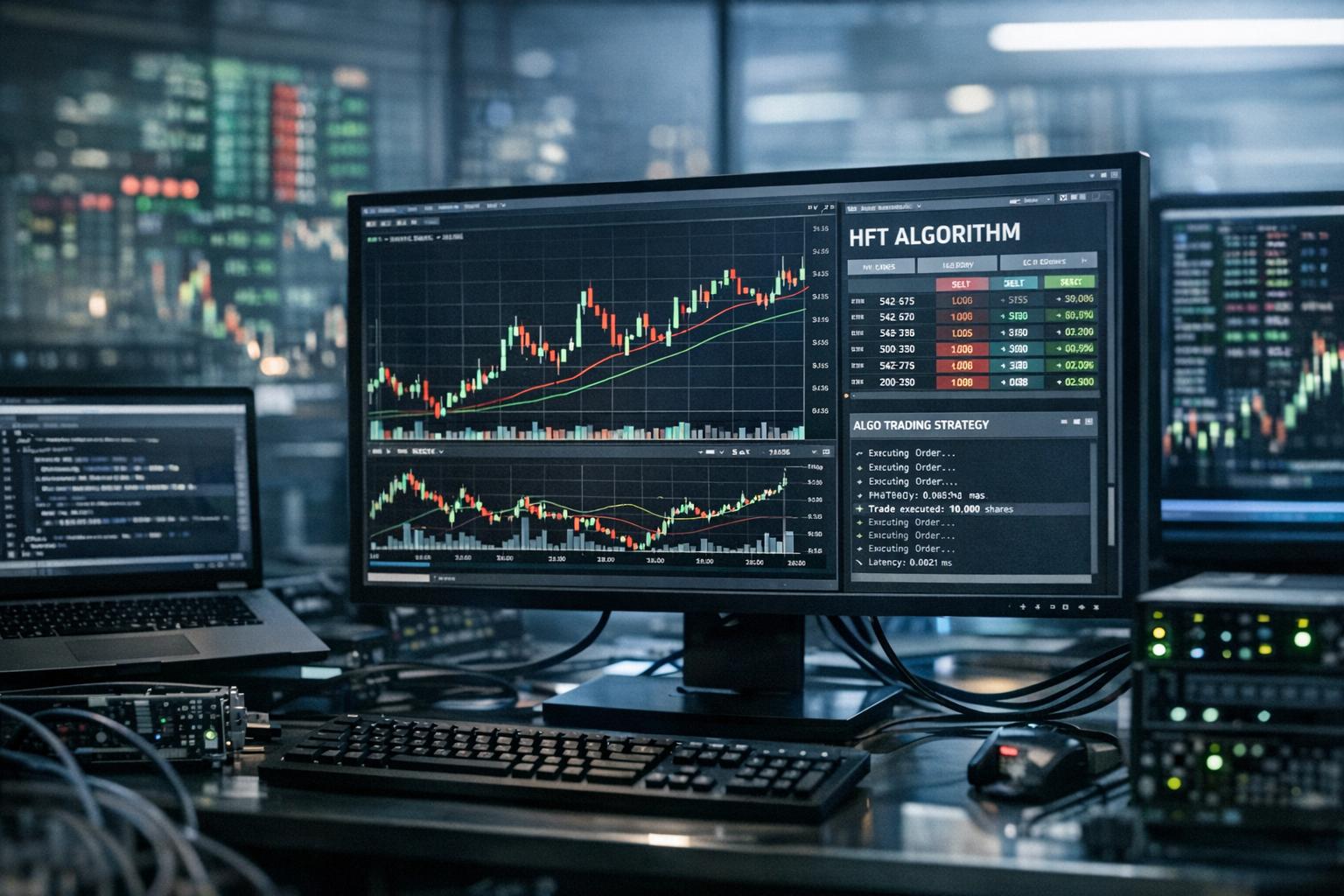
If you’re thinking about making your own high-frequency trading (HFT) software, you’re already ahead of most people who stop at “it seems fast.” But speed alone doesn’t pay the bills. What matters is latency, correctness, data handling, risk controls, and execution quality. The funny part is that HFT isn’t mostly about smart algorithms—it’s mostly about boring engineering that never gets a break.
This article walks through what it actually takes to build HFT software: architecture, market data plumbing, order management, backtesting realities, exchange constraints, and the risk controls that keep your account from becoming a cautionary tale. The goal is practical understanding, not a fantasy of press-a-button profits.
What “high-frequency trading” really means
HFT is usually described as “trading at high speed,” but that’s a surface-level definition. The working definition most developers end up with looks like this:
– You trade with very short holding periods or very fast reaction to market changes.
– You rely on low-latency systems so decisions align with the market you observed.
– Your edge comes from a combination of execution quality, microstructure effects, and data accuracy, not just forecasting.
Also, “high-frequency” is relative. A retail system making updates every few seconds is frequency in the low sense, but an exchange feed handler updating orders within milliseconds is frequency in the real sense.
The important implication: if your system isn’t correct and robust, being fast just speeds up your mistakes.
Before code: the constraints that shape your design
Most HFT projects fail long before the first line of strategy logic. They fail when you realize how limited the environment is.
Exchange rules and onboarding
Each trading venue has its own rules: order types, message formats, throttle limits, risk controls, and the exact meaning of timestamps. Some markets are more forgiving; others require careful compliance with message pacing and order lifecycle semantics.
A few things to check early:
– Order book depth and data feeds: do you get top-of-book only, full depth, or only trades/quotes?
– Timestamp source: when you say “time,” does it match your system clock or theirs?
– Order throttles: you might be limited in how many new orders per second you can submit.
– Cancel/replace behavior: some venues charge for cancels, or treat “replace” differently than cancel+new.
You need these answers because they determine how your order management system (OMS) behaves under real load.
Latency isn’t one number
Latency has multiple components:
– Network latency between your system and the venue (including switches, peering, and packet buffering).
– Processing latency inside your app: parsing, serialization, matching logic, state updates.
– Queueing latency when your system is busy or your threads are delayed.
– Trading instruction latency: time from decision to order submission and acknowledgment.
A common beginner mistake: measuring only “time to place order” and ignoring that your market data might already be stale when you make the decision.
Correctness beats cleverness
HFT systems make decisions from a local state representation of the exchange. That state must match reality. You’ll fight issues like:
– missed messages during reconnects,
– sequence gaps,
– out-of-order processing,
– partial updates (depending on feed type),
– and mismatch between what you think the order status is vs. exchange-confirmed status.
If your system drifts from exchange state, your “fast strategy” buys and sells at times you never intended.
System architecture for HFT software
A clean high-level architecture helps you avoid the classic problem: building a strategy that assumes its inputs are perfect, while the rest of the system quietly runs late or wrong.
Core components
Most practical HFT systems break into these building blocks:
Market data ingestion (MD)
Reads from exchange feed(s), normalizes message formats, checks sequence correctness, and updates an internal order book / quote / trade state.
Strategy engine
Consumes market state changes (or derived features), produces desired actions: new orders, cancels, or modifies.
Order management system (OMS)
Translates desired actions into exchange messages, tracks open orders, handles acknowledgments and fills, and enforces risk limits.
Risk and compliance layer
Stops trading when something is wrong: max position, max orders, max loss, kill switches, fat-finger protection, and operational alarms.
Persistence and audit logging
Stores enough data to reconstruct events for debugging. Yes, that logging can slow you down if you do it naïvely, so HFT systems often separate fast in-memory logging from asynchronous storage.
Time and clock sync
You need consistent timestamps across components, usually via clock synchronization (often NTP for many systems, sometimes more advanced time solutions depending on venue and requirements). Your code must assume clocks can drift.
Event-driven design
For many HFT use cases, an event-driven architecture works better than a loop that “polls” state. Market data arrives, you process it, and downstream components react.
However, event-driven doesn’t mean “random threads everywhere.” You still need control over threading and ordering.
A useful mental model:
– One thread (or carefully bounded set) owns the market state.
– Strategy reads snapshots or processes updates sequentially.
– OMS executes orders and updates order state.
If you let multiple threads mutate the same state freely, you’ll start chasing race conditions that show up only when the market is moving fast. That’s a fun hobby. Not a stable business plan.
Market data: the difference between “it works” and “it trades”
Your strategy lives or dies by data quality. HFT doesn’t excuse bad data; it multiplies its damage.
Feed types and what you actually need
Common data feed types include:
– Trades (executions with price/size/timestamp)
– Top-of-book quotes (best bid/ask updates)
– Full order book depth
– Incremental updates to the book (price level changes)
If you want to do market making or order book dynamics, you usually need more than trades alone. But the more depth you consume, the more bandwidth and processing you need.
The “minimal viable” feed for a first attempt depends on the strategy:
– If you’re doing simple execution timing based on trades, trades can be enough.
– If you’re doing liquidity provision, you need quote/book depth updates.
Sequence checking and recovery
Most exchange feeds include sequence identifiers. Your system should:
– track the last sequence processed,
– verify continuity,
– and request a snapshot or resync when you detect gaps.
This is where many amateur systems fail. They reconnect and continue “best effort” without reconciling the book state. Markets don’t care about your best intentions.
Order book representation
You need an internal structure to track:
– best bid and ask,
– depth at price levels (if required),
– volume aggregates per level,
– and sometimes queue position proxy metrics (depending on data availability).
Implementations vary. At minimum, you should support fast updates:
– update a price level amount,
– remove a level when it hits zero,
– retrieve price level or best price quickly.
If you do full depth with high tick counts, keep it efficient. A straightforward dictionary and sorting may work for prototypes, but it will collapse under load.
Timestamping: aligning your “now” with the exchange “now”
You’ll see multiple timestamps:
– feed event time from exchange,
– receipt time on your system,
– and local processing decision time.
These aren’t interchangeable. If you’re backtesting using one timestamp and live trading using another, your performance expectations won’t match. Plan your timestamp pipeline early and keep it consistent.
Execution: building a real-order workflow
HFT execution is a careful dance with an agar-eating dragon: orders can be rejected, partially filled, canceled, modified, delayed, or acknowledged out of sequence depending on your handling. You need to manage the lifecycle rigorously.
Order states you must handle
Your OMS should model at least:
– Submitted (you sent it, awaiting confirmation)
– Acknowledged (exchange accepted)
– Open (active in the book)
– Partially filled
– Filled
– Canceled
– Rejected
– Expired (if applicable)
Many bugs come from ignoring one of these states and assuming a happy path.
Acknowledgments and message ordering
Even if the exchange processes sequentially, network and your own threading can reorder events as they arrive. The OMS must either:
– enforce ordering guarantees within a single feed/connection,
– or buffer and sort events by local arrival sequence,
– or validate order status transitions.
What you cannot do is update positions based on a fill you believed belonged to a different order. That’s how accounts vanish.
Order types and how they change your system
Your choice of order types shapes your OMS complexity.
– Limit orders: simpler conceptually, but you need book-state tracking to estimate fills.
– Market orders: you need to understand slippage and potential rejection rules (some venues don’t allow market orders in all cases).
– Post-only: useful in market making to avoid taker fees / unwanted fills; but you must handle exchange behavior when post-only would cross the spread.
– Immediate-or-cancel / fill-or-kill: requires careful fill handling.
A “basic HFT” system often starts with limit orders and simple cancel logic. That’s not the sexiest plan, but it’s the one that survives daylight.
Backtesting: why results often disappoint (and how to avoid lying to yourself)
Backtesting HFT strategies is deceptively hard. Many backtests produce paper profits that evaporate live, sometimes faster than your CPU fan spins up.
What a correct HFT backtest must model
At minimum, backtests should include:
– realistic spread and bid/ask evolution,
– order book updates in correct sequence (not just price series),
– your order submission timing relative to the data events,
– queueing and fill probability assumptions,
– fees and rebates,
– and cancellation timing.
If you don’t model cancellation lead time, your backtest will assume you pulled orders instantly. Live systems frequently do not.
Latency in backtesting: treat it as a first-class parameter
When people say “we used historical data,” they often ignore that their strategy reacts at time t to a market event at time t, but in live trading, the event arrives after some delay.
A better approach:
– estimate a latency model (even a rough one),
– shift your decision time accordingly,
– and simulate that the market moved between observation and order submission.
You don’t need perfect latency modeling on day one, but you do need something more honest than “instant execution.”
Slippage and partial fills
Realistic execution simulation matters. If you assume a passive order fills whenever the market reaches your price, you might overestimate fills. If you assume a limit order never fills unless it trades exactly at that level, you might underestimate adverse selection.
Partial fills are also common. If your system doesn’t model partial fills, your position sizing and risk will be wrong.
Avoiding look-ahead bias
Look-ahead bias is when your backtest uses information that wouldn’t have been available at the time. For HFT, this often happens when:
– you apply book updates in the wrong order,
– you use “current best bid/ask” without ensuring it matches your message boundaries,
– or you fill orders using future updates.
Your best defense is a strict event replay system that processes messages in order and makes decisions only at the correct simulated times.
Risk controls: the part everyone skips until the worst moment
HFT is not forgiving. The system can execute dozens of orders per second. With that comes the need for strict risk management.
Core risk limits
You should implement hard limits such as:
– maximum position per instrument,
– maximum notional exposure,
– maximum losses per time window,
– maximum number of open orders,
– maximum order submission rate,
– kill switch that cancels all orders and stops new actions.
Not fancy. Just firm and measurable.
Order-level sanity checks
Before sending orders, validate:
– price bounds (doesn’t exceed a threshold),
– size bounds,
– instrument mapping correctness,
– and account/venue permissions.
Basic checks prevent the “oops I sent BTC orders to an ETH symbol” sort of problems. If you’ve never done something like that, you haven’t coded enough in production.
Kill switch design
A kill switch must work even during partial failures. If your feed thread crashes, your system must not blindly continue using stale state. The simplest rule:
– if market data is stale beyond a threshold, stop trading.
This is called “don’t trade on old news.” It’s also called “try not to donate money.”
Performance engineering: where the real work hides
You don’t need to build a space shuttle. But you do need to respect performance constraints. HFT performance work typically focuses on a few areas.
Threading model and data sharing
A common performance pattern:
– One thread reads market data and updates state.
– One thread runs the strategy and writes desired actions to a queue.
– One thread runs OMS and sends orders.
Queues decouple components and help limit blocking. But you must still manage memory allocation carefully. Avoid per-message allocations if you can.
Garbage collection and memory pressure
If you use languages with garbage collection, be aware of allocation patterns. GC pauses can turn “HFT” into “late-frequency trading.” Many high-performance systems minimize allocation during steady-state processing.
Not every project needs extreme optimization, but you should profile early and avoid building on assumptions like “the GC won’t happen.” It will. It always does.
Serialization and message handling
Your feed handler and OMS will parse and serialize messages constantly. You want:
– efficient parsers,
– minimal string creation,
– and reuse of buffers where possible.
For prototypes, clarity matters more than micro-optimizations. For live, you’ll likely end up tightening those hot paths.
Batching and pacing
Order pacing rules enforce throttles. Even if your strategy produces thousands of actions, your OMS must pace safely. Incorrect pacing can trigger disconnects or risk.
A good design separates:
– strategy intent (what you want)
from
– execution rate limits (what you’re allowed to do).
Strategy design: start simple, then earn complexity
If you jump straight to complex statistical arbitrage, you’ll likely spend weeks debugging the data pipeline instead of trading. Start with something that requires you to practice the system mechanics.
Market making basics
A common first HFT strategy is a simple passive market maker:
– post bid and ask around the mid price,
– adjust based on spread and inventory,
– cancel/replace on changes.
This tests your book update logic, OMS behavior, cancels, and risk controls.
But market making isn’t automatic profit. It’s a structured way to earn spread while managing adverse selection and inventory risk.
Execution timing (microstructure-aware)
Another entry point is “execution timing”:
– react quickly to book changes
– decide whether to submit or delay based on short-term liquidity signals.
This helps you test order rejection handling and latency effects without needing complex forecasting.
Statistical signals with strict guards
If you do any statistical modeling, you must add guards:
– signal thresholds to avoid constant small trades,
– regime filters,
– and robust estimation windows that won’t break on missing data.
Also remember: HFT isn’t just about whether the signal is correct; it’s about whether execution quality preserves the edge.
Paper trading, then simulation, then live with training wheels
Testing is not a single phase. It’s several layers.
Unit tests and replay tests
At the software level:
– test message parsing,
– test sequence gap recovery,
– test order lifecycle transitions,
– test position updates from fills.
At the system level:
– replay captured market data and feed it through your pipeline exactly as in production,
– compare your internal state against expected outcomes.
This catches many bugs that would only appear when the market does something annoying.
Sandbox or paper trading
Paper trading is mostly about validating integration:
– you connect,
– you receive data,
– you place/cancel orders,
– and you handle rejects and partial fills.
It won’t replicate slippage, latency tail events, or risk rules exactly. But it’s a stage worth doing, especially for OMS correctness.
Live trial with small size
When you go live, you start with:
– low notional,
– slow strategy parameters (fewer cancels/orders),
– and strict kill switches.
HFT systems fail in weird ways. You’d prefer to discover them when the cost is small.
Data capture and audit logging (without self-sabotage)
If you can’t debug the past, you can’t improve the next version.
What to log
You generally want logs for:
– market data messages (or at least hashes / sequence IDs),
– order submission and acknowledgments,
– cancels/replaces,
– fills, partial fills,
– position and risk state changes.
Also capture configuration parameters used for each run. A strategy that changed one threshold but not the configuration file is… a classic.
Logging approach
Standard logging frameworks can be slow and allocate memory heavily. In HFT systems, you often use:
– lock-free queues for log events,
– asynchronous writers,
– and binary logging formats.
You don’t need to be extreme on day one, but at least avoid logging in a tight hot loop in a way that stalls your processing thread.
Common failure modes (the “yeah, that happens” list)
No excessive list here, but you should recognize patterns.
State drift between OMS and exchange
If your OMS believes an order is pending when it was already canceled, or it thinks a fill is complete when it’s partial, your subsequent orders and risk checks become wrong.
Latency tails
Most systems do fine in average latency. HFT pain usually comes from tail events: GC pause, network hiccup, packet delay spikes, CPU scheduling anomalies. A strategy that works perfectly at 95th percentile latency might still fail at 99.9th percentile.
Backtest realism mismatch
If your backtest treats all executions as ideal, your live trading will show different results, especially in fast-moving spreads. Your cancellation timing will be wrong, fills will be wrong, and suddenly “the edge” isn’t there.
Overfitting a strategy to historical noise
A strategy that looks brilliant in a backtest window can be a coincidence machine. If you don’t test across multiple periods and instruments, your “edge” may just be a flattering chart.
Technology stack choices for building HFT software
You can build HFT software in various languages, but the trade-offs matter.
Language considerations
– C/C++ can offer low-level control and minimal overhead, but longer development time.
– Rust aims to combine performance with memory safety; many HFT shops like it for correctness without garbage collection pauses.
– Java can work with careful GC tuning and off-heap strategies, but you must validate tail latency.
– Go can be fast, but scheduling and GC behavior need careful profiling.
– Python is fine for research, backtesting prototypes, and glue code, but for real-time order handling and low-latency paths you’ll usually push the hot parts elsewhere.
In practice, many systems use a hybrid approach:
– Python for research, feature generation, and offline work
– a compiled language for market data and OMS hot paths
Networking and messaging
Your system will rely on socket performance, message parsing, and buffer management. If you’re using an exchange-provided API, consider how it affects latency and reliability. Some APIs are great for correctness and ease of use; others are built for general trading and not for strict low latency.
Time-series storage vs operational logging
Separate “data lake” storage from operational logs. Don’t write a high volume of raw feed messages synchronously from your hot path. Use asynchronous capture, and store snapshots or compact logs.
Regulatory and operational realities (not optional)
Even if you’re building for personal use, you’re still trading in regulated markets, or at least operating under exchange rules that have consequences.
Operational security
If your system can place orders, it needs access controls, secure credentials handling, and safe deployment practices. That includes:
– separate API keys for paper vs live,
– least-privilege permissions,
– and a process to revoke keys quickly if something changes.
Monitoring and incident response
You need monitoring that tells you when:
– feed connections are stale,
– order submission rates exceed expectations,
– positions deviate from risk model,
– or OMS processing falls behind.
Also have a plan: who cancels orders, how quickly, and how you confirm everything is flat. In production trading, “I think it’s fine” is not a monitoring strategy.
A practical build plan (from prototype to something you can test)
Here’s a staged plan that won’t waste months.
Stage 1: build the feed handler and state tracker
Goal: maintain a correct internal representation of the order book or quotes.
– connect to the feed,
– parse messages,
– apply them to your state,
– validate with sequence IDs,
– add reconnect recovery.
If this stage is wrong, strategy doesn’t matter.
Stage 2: build the OMS with strict state transitions
Goal: place, cancel, and reconcile order states.
– connect to trading endpoint,
– submit limit orders,
– handle acknowledgments,
– update internal order state from exchange messages,
– validate position changes.
At this stage, run a “do nothing” strategy that places orders based on simple rules, then cancels after a short interval. It’s not about profit. It’s about proving your workflow.
Stage 3: add risk controls and a kill switch
Goal: prevent runaway trading.
– enforce max position, max order count,
– implement kill switch to cancel everything,
– stop trading when feed is stale,
– add fail-safe behavior for rejected orders.
Without this stage, you’re building a wheeled object with no brakes.
Stage 4: implement one basic strategy and simulate latencies
Goal: test logic without risking much.
Choose either:
– simple market making,
– or execution timing based on book changes.
In backtesting, model:
– realistic cancellation timing,
– partial fills (as supported by your assumptions),
– and fees.
Then run replay tests with recorded data so you’re not guessing about state correctness.
Stage 5: paper trading, then limited live
Goal: validate integration under real conditions.
Paper trading confirms:
– you can operate continuously,
– handle rejects,
– and keep state consistent.
Then limited live:
– low size,
– conservative parameters,
– and strict monitoring.
Making “your own HFT software” without reinventing the pain
You might be tempted to design every component from scratch. That’s the programmer’s version of “I’ll bake my own flour.” Sometimes it’s fun. Often it’s not required.
Instead, consider what to build vs what to adopt:
– If an exchange provides an SDK for order entry and parsing, it may reduce risk of protocol mistakes.
– You can still implement your own internal state tracker and strategy engine while using the SDK for connectivity.
– If you require low latency and have serious throughput needs, you may replace higher-level APIs with direct protocol handling later.
The trade-off is engineering time vs correctness and performance risk. In HFT, correctness is still the king.
Common questions people ask when planning an HFT build
Do I need to co-locate to be successful?
Not always. Co-location can reduce latency significantly, but it’s expensive and operationally complex. Many HFT strategies rely on execution and microstructure effects that can still be partially captured without co-location, especially if your strategy tolerates latency.
If your plan requires sub-millisecond reactions, you’ll likely need a serious setup. If your plan tolerates a few extra milliseconds, you may still find edges through better modeling and risk controls.
Is bid-ask data enough?
For some strategies, yes. For others—especially anything involving order book depth dynamics—you need deeper feed data. In general, the more your strategy depends on queue position or depth changes, the more you need full book or depth updates.
What hardware do I need?
You need predictable performance. HFT performance is often about reducing jitter:
– fast CPUs,
– stable clock/time sync,
– and careful core pinning if your OS scheduling introduces variability.
Also, you need enough memory to keep state. Depth feeds can be large.
Details depend on how many symbols, how deep the book, and your order/cancel frequency.
How do I know my system is correct?
You validate with:
– sequence gap tests,
– replay comparisons,
– order state transition tests,
– and reconciliation between your internal position and exchange-confirmed position.
Then you run small live tests with monitoring to confirm behavior under real conditions.
Reality check: what an HFT project actually feels like
Most people think HFT is math. In practice, it’s mostly plumbing, strict state management, and the occasional moment where you realize the documentation was technically correct but operationally misleading.
The part that stays consistent across projects:
– you fight clock and timestamps,
– you fight reconnection handling,
– you fight edge cases in order lifecycle,
– and you learn that “fast” without correctness is just speed-running mistakes.
If you still want to build it, that’s fine. Just go in with eyes open, and don’t treat the first version like a money printer. Treat it like a correctness machine that earns the right to make trades.
Conclusion: building HFT software is a full engineering job
Making your own high-frequency trading software is doable for individuals and small teams, but it’s not a weekend project or a place to wing it. You’re building a real-time system that interacts with exchange protocols, processes streaming market data, and places orders under strict rules. Success depends less on a clever strategy and more on data correctness, execution state management, latency handling, and risk controls.
Start with the feed handler and OMS. Make correctness boring. Then add strategy. If you do that in the right order, you give your system a chance to survive contact with live markets—and yes, markets have a talent for being rude.
If you want, tell me what market/venue type you’re targeting (crypto vs equities vs futures), what feed you expect (quotes vs full depth), and whether your plan is market making or execution timing. I can suggest a more concrete architecture and a reasonable “first strategy” scope.