Introduction: what “make your own swing trading software” really means
Making your own swing trading software sounds like a programming project, but it is really three projects sitting on top of each other. It is a market access project, because the software has to connect to a broker or data source that actually supports the workflow you want. It is a process design project, because swing trading only works when screening, entries, exits and risk controls are defined clearly enough to automate or at least semi-automate. Only after that does it become a coding project. The mistake most people make is starting at the wrong end. They ask what language to use before deciding what the software is supposed to do. That is why it helps to start with the actual infrastructure offered by firms like Alpaca and the Interactive Brokers API.
For swing trading, the software usually does not need to behave like a high-frequency engine. It does not need microsecond routing, colocation or a room full of blinking screens. It needs something else. It needs clean daily and intraday data, a reliable way to screen instruments, a repeatable entry and exit engine, position sizing, order handling, logging, and a review loop. In many cases, the best swing trading software is not fully automatic. It is semi-automatic. It scans the market, ranks setups, sizes trades, prepares orders and records outcomes, while the trader keeps final control. That is often better suited to swing trading than pretending every decision must be delegated to code. Providers such as Polygon and the Interactive Brokers TWS API already make that type of structure possible.
There is also a regulatory angle that people overlook. If you are building software around U.S. equities in a margin account, you should understand how your activity might interact with day-trading rules, even if your intention is to swing trade. FINRA still defines a pattern day trader as a customer who executes four or more day trades within five business days, subject to the familiar percentage threshold, though FINRA has proposed changes to those older provisions in 2026. That does not make swing trading difficult, but it does mean the software should know what kind of activity it is generating rather than accidentally drifting into something else.
So the useful goal is not “build a trading bot.” The useful goal is to build a process machine that helps you find, manage and review swing trades with less noise and better discipline. I recommend that you visit the website Swing Trading to make sure that you understand exactly what features and quality your swing trading software is going to need.
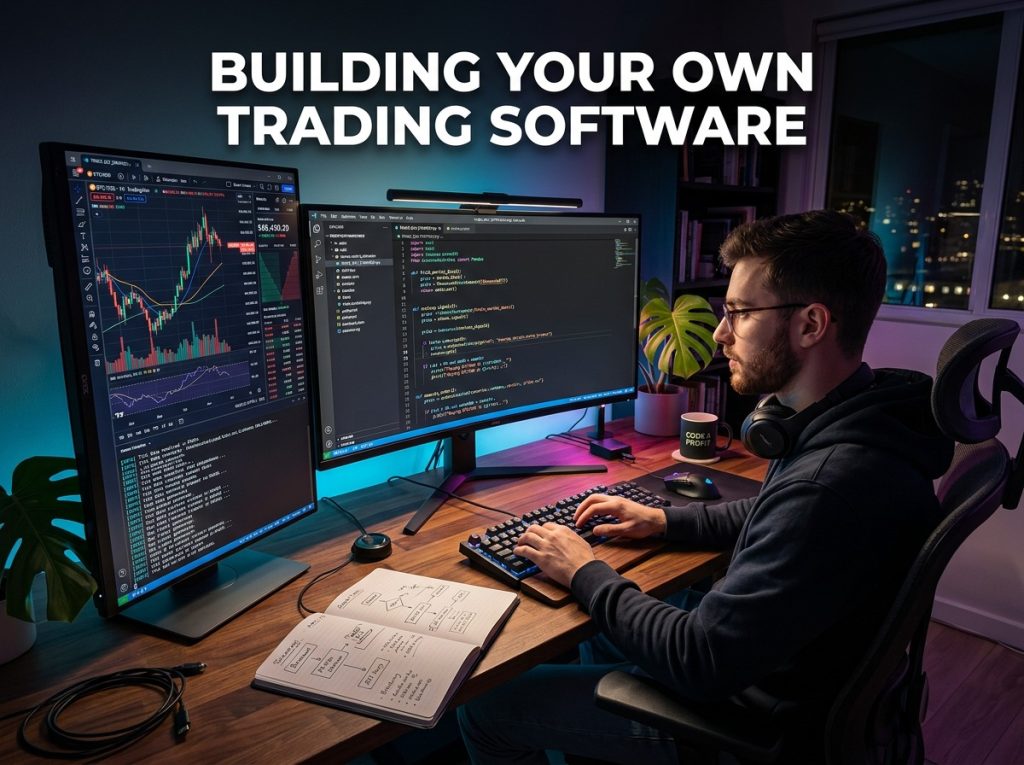
Market structure and scope: choose the market, broker and level of automation first
Before you write code, decide what market the software is for. Swing trading stocks, ETFs, futures, forex and options all require different data models, different broker permissions and different order logic. A stock swing trader can build around end-of-day scans and simple bracket orders. A futures swing trader needs to think harder about margin, contract roll and overnight risk. An options swing trader needs contract selection, greeks awareness and expiration logic. If you do not decide this early, the software will drift into an awkward compromise that handles none of them well. Both the Interactive Brokers API and Alpaca’s algorithmic trading tools make this clear, because the design choices depend heavily on the asset class and order workflow.
The next choice is broker and data provider. This is more important than the tech stack. Alpaca says its APIs allow developers to access real-time price data, place orders and manage portfolios through REST and streaming interfaces. Interactive Brokers says its TWS API can retrieve data and send orders autonomously through Trader Workstation or IB Gateway, with support for Python, Java, C++, C# and other languages. Polygon says its stock APIs and WebSocket feeds support real-time trades, quotes and aggregates. That means the core inputs already exist off the shelf. You do not need to build a broker or a market data plant. You need to build the logic that sits between them.
Then decide how automated the system should be. Full automation sounds attractive, but for swing trading it is often unnecessary. A semi-automated system can screen the universe after the close, flag setups, calculate entries and stops, and then let you approve the trades. That reduces human error while keeping human judgment where it still matters. A fully automated system makes more sense when the rules are rigid, the order flow is simple and the account size is small enough that operational mistakes are survivable. The tighter your strategy rules, the more sensible automation becomes. The fuzzier your process, the more likely the code will simply automate your own confusion.
This is why scope control matters. Build one thing first. Build, for example, a stock and ETF swing scanner with order preparation, journaling and broker integration. Do not start by promising yourself a multi-asset portfolio manager, options engine, sentiment model and machine-learning signal stack. Retail trading software usually fails because it becomes ambitious long before it becomes reliable.
Core architecture: data, signals, portfolio logic, execution and review
A useful swing trading system has five practical layers. It needs a data layer, a signal layer, a portfolio layer, an execution layer and a review layer. You can package them however you want, but if one of them is missing the software becomes either a chart toy or an order-entry shortcut.
The data layer comes first. Swing trading does not need tick-perfect infrastructure, but it does need clean historical bars, corporate action awareness, and enough intraday context to place and monitor trades sensibly. Polygon’s stock products are built around REST APIs, WebSockets and aggregate bars, while its documentation explains how aggregate bars are formed. Alpaca also offers real-time stock, options and crypto market data through its APIs. The point is not that these are the only possible providers. The point is that a serious swing system should use a data source whose behavior is documented and whose update model you understand. If your daily bars shift because your source handles splits badly or your intraday feed is inconsistent, the software will look broken even when the code is fine.
The signal layer is where the strategy begins. In swing trading, this usually means screening a universe for conditions such as trend strength, pullbacks, breakouts, relative strength, volatility compression, earnings gaps or sector rotation. The exact rules are not the important part here. The important part is that they must be explicit enough for software to evaluate consistently. A system that says “find quality setups” is not a system. A system that says “find stocks above the 50-day moving average, pulling back less than 5 percent from a 20-day high, with rising relative volume and no earnings in the next two sessions” is at least something code can work with. The software should not have to guess what you mean by a setup.
The portfolio layer is what separates a screening tool from a trading application. This layer decides how many positions you can hold, how correlated they are, how much capital each can consume, and what happens when several valid signals appear at once. Most traders spend too much time on entries and too little time on portfolio construction. Software helps because it can rank opportunities and enforce limits without getting excited. If your process says no more than two semiconductor names at one time, or no more than 5 percent of portfolio risk in one sector, then the software should enforce that. Otherwise it is not protecting the process, it is merely decorating it.
The execution layer should be dull and strict. IBKR’s TWS API is built around retrieving market data and sending orders through Trader Workstation or IB Gateway. Alpaca’s trading APIs similarly support order placement and portfolio management. For swing trading, the execution logic should usually prefer simple order types and clear state transitions: pending, submitted, accepted, partially filled, filled, canceled, rejected. Do not make this layer clever. Make it reliable. Many self-built systems fail because they can identify a setup but cannot keep accurate track of what actually happened after the order left the machine.
The review layer is the one most hobby projects ignore. Every decision should be logged with enough detail to reconstruct it later: the data snapshot, the signal state, the ranking score, the position size, the order ticket, the fill result, and the eventual outcome. If the software cannot explain why it took a trade, you cannot improve it. If it cannot explain why it skipped a trade, you cannot trust it. Good swing trading software remembers better than you do. That is half the job.
Strategy engine design: screening, entries, exits and risk controls
The strategy engine is the part traders love to romanticize, but for swing trading it is usually simpler than the internet makes it sound. Most workable swing systems are just combinations of three ideas: trend, pullback and breakout. Software becomes useful when it applies those ideas consistently, not when it tries to look profound.
Start with screening. Your engine should know what universe it is scanning and why. That can mean liquid U.S. large-cap stocks, sector ETFs, growth names above a certain dollar volume threshold, or any other universe you can justify. The software should exclude instruments that are too illiquid, too gappy or too close to known event risk if your process avoids those. If you are using U.S. equities, it can also help to tag earnings dates and major corporate events so the system does not accidentally treat an earnings coin flip as a textbook swing setup.
Then come entries. The best swing software does not just shout “buy” or “sell.” It proposes an entry zone, a stop level and a thesis invalidation point. That matters because swing trading is a risk-first business even when traders pretend it is a chart-pattern business. An entry without a defined stop is not software assistance. It is just faster indecision. The program should calculate position size from account risk, stop distance and instrument price, not from whatever share count happens to look tidy.
Exits deserve the same seriousness. A lot of homemade systems are obsessed with entries because entries feel exciting. In real trading, exit logic matters at least as much. Your software should know when to take a partial gain, when to trail a stop, when to close on time, and when to get out because the original setup has degraded. Swing trading software also benefits from timeout logic. If a position has done nothing for a defined number of sessions, the system should recognize that dead money is still risk capital.
Risk controls are the real spine of the engine. The software should enforce daily, weekly and portfolio-level risk limits. It should know the difference between gross exposure and net exposure. It should understand correlation well enough not to fill the book with what is really the same trade repeated through related names. It should also know when to shut up. A good system often helps most by refusing to produce trades when market conditions are poor.
This is where the machine starts becoming more useful than manual discretion. It does not get bored and start inventing patterns on a flat chart. It does not take a sixth trade because the last five were frustrating. It either finds the setup or it does not.
Testing and deployment: backtesting, paper trading, monitoring and failure handling
Testing a swing trading system is easier than testing high-frequency infrastructure, but that does not make it easy. The first stage is historical backtesting. This is useful for finding obvious nonsense, checking whether your rules behave roughly as expected, and estimating how often signals appear. It is not proof. Historical results are heavily shaped by data quality, survivorship bias, corporate actions and the very human temptation to optimize rules until they fit the past too neatly.
That is why the second stage matters more: paper trading on live data. Alpaca explicitly offers paper trading and real-time market data for algorithmic workflows. That makes it a sensible environment for testing signal generation, order routing and portfolio state without immediate capital risk. In practice, paper trading is where many systems reveal that the backtest was the easy part. Signals arrive at awkward times, prices move between calculation and order submission, APIs return messy edge cases, and the software does things you never asked it to do because you forgot to define one small branch of logic.
Monitoring is the next layer. The software should tell you whether the data feed is alive, whether the broker connection is healthy, whether orders are stuck in unusual states and whether portfolio exposure matches expectation. Swing trading software does not need a war room, but it does need alerts. If your connection to IB Gateway through the TWS API drops, or your Polygon WebSocket feed goes stale, or your portfolio reconciliation fails, you should know immediately. The point of automation is not to go blind. It is to reduce routine work while keeping the important controls visible.
Failure handling is the least glamorous part and one of the most important. What happens if the market data feed lags? What happens if the broker accepts the order but your application never receives the confirmation? What happens if your machine restarts with open positions? Swing trading is slower than scalping, but operational failure still matters. Your software should be able to recover state, reconcile open positions with the broker, and avoid duplicate orders after restarts. This is where many personal projects reveal that they were really demos pretending to be systems.
There is also a regulatory and practical reason to track your trade style. Even if your software is built for swing trading, it should know when it is drifting toward frequent intraday activity. FINRA’s current public explanation of pattern day trading is still the old “four or more day trades in five business days” framework, although changes have been proposed. A sensible swing system should not accidentally trip over this because its order logic keeps entering and exiting the same names intraday under stress. Investor.gov’s glossary entry is also worth keeping in mind if you are building around a margin account.
Testing, then, is not just about whether the strategy made money in the past. It is about whether the software behaves like a grown-up system in the present.
Conclusion: build a process machine, not a fantasy machine
The useful version of homemade swing trading software is not a black box that promises to outsmart the market while you make coffee. It is a disciplined tool that screens better than you can by hand, sizes risk more consistently than you do under pressure, routes orders cleanly, and keeps records you can actually learn from. The broker and data side is already available through documented APIs from firms such as Alpaca, Interactive Brokers and Polygon. The hard part is not access. The hard part is forcing your process into rules that are clear enough to survive contact with reality.
That is the real standard. Build software that makes you more systematic, not more imaginative. The market already supplies enough imagination on its own. The software should supply discipline.