What “make your own binary options trading software” really means
Making your own binary options trading software sounds like a coding project. It is not only that. It is a market structure project, a risk control project, and only after that a software project. Most retail discussions begin at the wrong end. They start with the interface, the indicator set, or some fantasy about a bot that prints money while the owner sleeps. That is not how this product works. Before writing a line of code, you need to know what instrument you are building for, which venue can lawfully offer it, how the payout actually works, and whether the software is for manual decision support, automated execution, backtesting, or all three.
The definition itself is simple. The SEC’s Investor.gov glossary says a binary option is a contract whose payout depends entirely on the outcome of a yes or no proposition. If the condition is met at expiry, the holder receives a fixed cash amount. If not, the payout is nothing. That simplicity is why many traders want software around it. A contract with a fixed yes or no structure seems easy to automate. Compared with standard options or futures, the decision logic looks cleaner.
The problem is that easy to automate does not mean easy to profit from. Binary or event style contracts are strict on timing, harsh on expected value when pricing is poor, and historically surrounded by fraud when offered through bad venues. The SEC and CFTC investor alert on binary options fraud is still one of the more useful documents in this area because it reminds people that the platform itself can be a larger risk than the trade idea.
So if you want to make your own binary options trading software, the sensible goal is not to build a magical winning bot. The sensible goal is to build a disciplined system that can read market data, apply rules consistently, control risk, and interact only with a venue whose legal status and technical interface you actually understand. Visit BinaryOptions.net to understand what a binary options trading software really need to be able to do better.
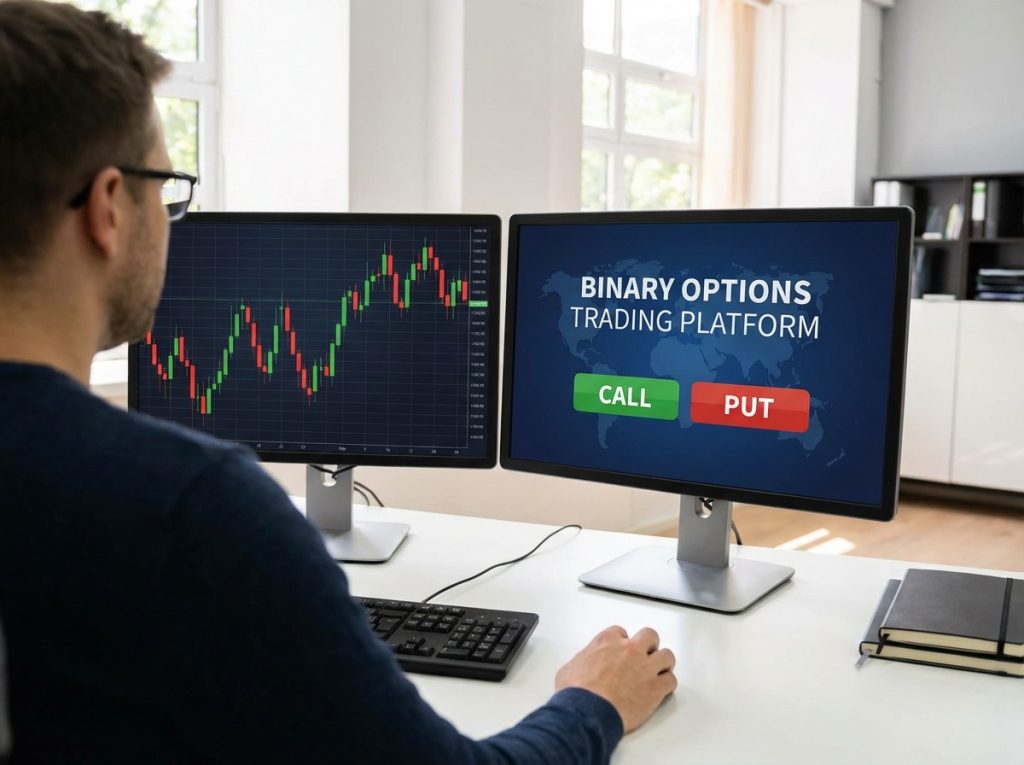
Market structure first: the legal and venue question before any code is written
Before software design comes venue design. This is the part most people skip because it is less fun than choosing a stack. In binary options, that mistake is expensive.
The first question is whether the product you want to trade is being offered on a lawful, regulated venue in your jurisdiction. In the United States, this point is unusually important. Nadex states on its own product pages that event contracts are legal and available to trade in the U.S. only on a CFTC regulated U.S. exchange, and that it operates as a CFTC regulated exchange and clearing house. Whether or not you use Nadex specifically, the core point is right: if you are building software for this market, you need to know whether your target venue is a real regulated market or just a website with a nice logo and a questionable relationship to the law.
The CFTC has also been actively revisiting event contracts and prediction markets. Its March 2026 prediction markets notice explains that event contracts often have a binary payout structure and sit inside a still evolving regulatory discussion. That does not mean they are all prohibited. It does mean that if you are building software to interact with one of these markets, the legal status is not a footnote. It is part of the specification.
This changes the engineering task. You are not just building “binary options software.” You are building software for a specific venue, a specific contract model and a specific set of API or execution constraints. That means the first documents to read are not coding tutorials. They are the venue’s contract rules, market hours, order handling rules, fee schedule, authentication methods and any public documentation on programmatic access. If the venue has no stable API, then your software design changes. If the venue only allows manual execution, then your software becomes a signal and monitoring platform rather than a full auto-trader. If the venue is offshore, obscure, or legally dubious, the correct software design may be to stop the project there.
This is why many homemade trading tools fail before they are built. Their owners design for an imagined market rather than the actual one. A real project starts with real contract definitions, real settlement rules, real rate limits, real order states and real compliance boundaries. Anything else is software theater.
Core software architecture: data, signals, pricing, execution and logging
Once the venue is chosen and the market structure is understood, the software itself becomes straightforward in principle. A usable binary options trading system has five main layers. It needs market data intake, a strategy engine, a pricing and decision layer, an execution layer, and a logging and review layer. You can merge some of these in a small project, but conceptually they are separate jobs.
The market data layer is where everything begins. Your software needs timely price data for the underlying market and, if available, contract price data from the venue itself. These are not always the same thing. A common retail mistake is to generate signals from one feed and assume the contract will price identically on the venue. That assumption is often false at exactly the wrong time. For event contracts with fixed payouts, small timing mismatches matter more than many traders expect. If your software is using delayed or inconsistent price inputs, the rest of the stack becomes decoration.
The strategy layer is the rule engine. This is where your software decides whether the setup exists. That logic can be simple or complex, but it should be explicit. A decent system says something like this: only trade during defined market hours, only when volatility is inside a target range, only when price is above or below a reference level by a specified amount, and only when the contract’s implied risk-reward clears a minimum threshold. Most software fails because the strategy logic is vague. The code may be neat, the rules are not. Clean code cannot rescue muddy thinking.
Then comes the pricing and decision layer. This is especially important in binary options software because the contract’s value is binary but the purchase price is not. If you are buying a contract at a poor price, your edge may disappear even when the signal is decent. Your software therefore needs to evaluate not just direction, but entry economics. In plain terms, a bullish signal is not enough. The contract also needs to be cheap enough, or the probability estimate high enough, for the trade to make sense. This is where many hobby projects become glorified coin tosses. They automate the directional call and ignore the pricing logic.
The execution layer should be boring and strict. It should submit orders only when conditions match exactly, verify responses from the venue, handle rejection states and record every action. A good execution engine is not clever. It is defensive. It assumes networks fail, APIs timeout, orders are rejected, and duplicate submissions can happen if state handling is sloppy. In trading software, boring engineering is a virtue.
The logging layer is the part most people leave until after something breaks. That is backwards. You need full logs from day one. Record timestamps, data snapshots, contract identifiers, rule state, order requests, order responses, fills, failures and post-trade outcome. If your software cannot explain why it traded, it cannot be improved and cannot be trusted. Logging is not admin. It is memory.
A simple desktop interface can sit over all of this, but the interface is the least important part. Many retail projects spend too much time on dashboards and too little on data integrity and state management. The market does not pay for attractive buttons.
Strategy engine design: rules, timing, payout logic and risk controls
The strategy engine is where a trading application stops being a market viewer and becomes a decision system. In binary options, this engine has to be more careful than the product’s sales pitch suggests.
The first issue is timing. Binary options and event contracts are highly sensitive to expiry. A strategy that works for a one hour horizon may be useless at five minutes. Your software therefore needs expiry-aware logic. It should not just issue a direction. It should connect direction to a time window, a contract class and a market condition where that duration makes sense. If the code treats all expiries as interchangeable, the strategy is likely weak even if backtests look decent.
The second issue is payout logic. The SEC glossary makes clear that the payoff is fixed and all or nothing at expiry. That means the strategy engine must think in expected value, not just signal frequency. A 60 percent win rate may still be poor if the contract price is too high, while a lower win rate may be acceptable if entry pricing is favorable enough. Many retail bots ignore this entirely. They optimize for hit rate and then act surprised when the account drifts downward. A proper engine evaluates both estimated probability and contract price before taking the trade.
The third issue is risk control. The strategy engine should know when not to trade. That means hard blocks around major data releases if your logic is not built for event volatility, exposure limits across correlated contracts, daily loss limits, maximum number of open positions and session stop rules. A homemade system without these controls is not a serious trading application. It is a fast way to repeat the same mistake several times in a row.
This is also where people get tempted by martingale logic, progressive sizing after losses, or other mathematical self-harm dressed up as recovery systems. Leave that out. A robust binary options system should reduce freedom after stress, not increase aggression. Loss controls are the spine of the software. Without them, the rest is just a signal toy.
Testing and simulation: backtests, paper trading and failure modes
Testing matters more in binary options software than in many other retail systems because the margin for error is thinner. The first stage is historical backtesting, but this should be treated as rough screening rather than proof. Binary contracts are especially vulnerable to backtest distortion because timing, quote availability and venue-specific pricing can differ from the clean historical data set you are using. A backtest that relies only on underlying spot price and ignores actual contract pricing is useful only for early idea triage.
A better next step is event-level simulation using venue-like pricing assumptions. If the real venue offers a fixed payout contract at varying prices, then your simulation needs to model entry price, time decay toward expiry, fees and slippage or fill assumptions where relevant. Without that, your results are mostly fiction. Traders often say a strategy “worked in testing” when what they mean is that a simplified spreadsheet liked the direction calls.
Paper trading is where the software starts meeting the real market. Use the live data flow, the real contract universe and the real signal logic, but keep capital out of it. This stage is not glamorous, and that is exactly why it is useful. You are checking whether the software behaves as intended, whether timestamps line up, whether contract selection is correct, whether the system avoids duplicate orders, and whether your logs are good enough to reconstruct every action.
Failure testing is just as important. Deliberately test what happens if the feed drops, the API returns partial data, the order response is delayed, or the clock on the local machine drifts. Many homemade trading tools fail not because the strategy is bad, but because the software behaves unpredictably under ordinary technical stress. A trading system does not need to be perfect. It does need to fail in a controlled way.
A serious system also needs post-trade review. Every signal should be classifiable as correct, incorrect, skipped for good reason, or executed badly due to software behavior. If you cannot sort trades that way, you are not yet testing the system. You are watching it.
Deployment and operations: security, monitoring and broker or exchange integration
When the software goes live, the engineering job changes. The risk is no longer only bad logic. It is also operational sloppiness.
Credentials and API keys should never live hardcoded inside scripts or in plain text files. Use environment variables or a secret manager. Store logs securely. Keep system clocks synchronized. Monitor whether the software is running, whether data is arriving, whether the venue is responding normally, and whether open positions are being tracked correctly. In automated trading, monitoring is not optional. Unattended systems drift into strange states faster than their owners like to believe.
Integration should also remain as simple as possible. One venue, one clean authentication method, one execution path, one state store. Retail developers often build too much too early. They add multiple feeds, multiple brokers, multiple models and several fallback paths before the core logic has even survived one stable month. Complexity should be earned.
There is also a legal point here. If the venue’s terms prohibit certain forms of automation, scraping or unofficial access, then your software design has to respect that. A clever workaround is usually not clever for long. In regulated markets, the rules around access are part of the operating environment, not a minor inconvenience.
Conclusion: build a system for discipline, not a machine for fantasy
Making your own binary options trading software can be a sensible project if the goal is structure, discipline and better decision support. It becomes nonsense when the goal is to automate hope. The market is already strict enough. Bad venues, weak pricing logic and poor risk controls make it worse, not better.
The right build starts with market structure, continues through clean architecture and explicit rules, and only then reaches automation. Use a regulated venue where possible, verify the contract model, log everything, and test failure states as seriously as you test winning trades. The SEC’s binary options definition, the CFTC’s event contract rulemaking discussion, and the SEC/CFTC fraud warning are a better starting library than most trading forums.
The useful version of this project is modest. Build software that enforces rules you can explain. The dangerous version is ambitious in all the wrong places. In binary options, the market usually notices the difference first.